Cultivate STEM Soft Skills Through Play

Written by: Liza Gresko, Mom and PR Specialist at Moss Tucker Group
It feels like parents began prioritizing STEM (Science, Technology, Engineering, and Math) with their kids in the early 2000s, with momentum building quickly after 2001 when the National Science Foundation introduced the acronym and the U.S. began emphasizing it in education.
But in reality, we have to look back a bit further. It was the National Science Foundation (NSF) which established guidelines for the teaching of science, math, engineering, and technology in grades K-12, that first raised the concept of STEM in education, introducing the acronym SMET. Back then, educators and policymakers found the term awkward and uninspiring. So, in 2001 the NSF officially rebranded the initiative STEM, and more recently STEAM, as “Art” was added, and parents took notice.
Interest surged further between 2009-2011 with federal initiatives, changing its focus from workforce security to essential early childhood critical thinking.
Today, STEM has become part of mainstream parenting, with 79% of parents believing STEM toys and games are important for skill development, and 85% of parents confirming they actively look for STEM or STEAM toys and games for their children all year long (The Toy Association).
Through these searches, parents tend to reach for the best educational board games for kids as the main play category to support math practice, reading readiness or science knowledge. But there’s another layer of learning that’s just as critical: STEM soft skills.
These are the skills that help children think like scientists, engineers, and innovators. Skills like spatial reasoning, planning, adaptability, creative problem-solving, and collaboration are at the forefront.
Finding the right toys and board games to support STEM soft skills can often be a daunting task. It seems like every children’s toy or game has a footnote of STEM educational support, promising STEM inspiration and stronger academics.
Some of the most effective learning happens through play-based, screen-free experiences. That’s why families are increasingly turning to screen-free coding games, spatial reasoning games for kids, and cooperative science games that build thinking skills naturally.
Why STEM Soft Skills Matter

STEM success relies more on how you get to the answer, not just about getting the right answer. According to The National Institutes of Health, engineers and scientists rely heavily on soft skills. For example, engineers repeat designs, programmers work through systems, and scientists test and re-test their hypotheses.
Educational standards utilized by mainstream curriculum across the country emphasize that children need opportunities to:
- Communicate
- Empathize
- Persevere & Adapt
- Work as a team
- Problem solve
Play is one of the most natural and effective ways to develop these abilities, especially when it’s hands-on and interactive, thus reinforcing those soft skills.
Spatial Thinking: Building the Foundation for STEM

Spatial thinking is a cornerstone of STEM learning. It helps children understand how objects relate in space, recognize patterns, and mentally manipulate shapes, which are skills that are essential for everything from geometry to coding.
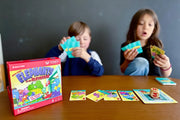
Corner Center Match is a great example of a spatial reasoning game for 5-year-olds. Each player tries to match the colors and shapes on the corners of their cards to the center shapes on the target cards. Players must identify matches and react quickly to stay ahead of the competition and be the first person to match all of their cards to win.
Unlike digital games, this hands-on experience allows children to physically manipulate pieces, reinforcing learning through touch and movement. It’s a powerful example of how screen-free coding games can build foundational logic skills without a device.
Planning: Learning to Think Ahead

Planning is at the heart of problem-solving. Whether designing an experiment or mapping out a solution, children need to practice how to anticipate outcomes and make thoughtful decisions.
Acorn Paws, is a game where players visually learn the principles of division. In each round, a new bag of acorns is poured into the center of the play area. Players count the acorns, and then select a card to play, trying to earn the largest share of the acorns. When all rounds are completed, the player with the most acorns wins the game.
In Uncle Beary’s Bedtime, children ages 3 and up must help Uncle Beary get the bear cubs to bed. Players roll the die and take turns moving cubs from toy tiles to their beds, or back. This delightful board game introduces planning at an early level. Young players must decide how to move their bear cubs based on dice rolls, balancing immediate gains with long-term goals. As they count and compare quantities, they also develop focus and self-control, which are important executive function skills.
These are some of the best games to demonstrate how educational board games for kids integrate planning into age-appropriate and entertaining challenges.
Adaptability: Learning to Pivot with Confidence

In STEM fields, failure is part of the process and the journey. Adaptability teaches children to adjust strategies, learn from mistakes, and persist through challenges.
Games like Uncle Beary’s Bedtime naturally build adaptability. Players have to respond to changing conditions and adjust their approach accordingly. This helps children become comfortable with uncertainty and develop resilience.
Through repeated play, children learn that success often comes from being flexible not being perfect.
Creative Problem-Solving: Encouraging Innovation

Creative problem-solving is where STEM meets STEAM. It’s about exploring possibilities, testing ideas, and creatively thinking outside the box.
Bug Crafts offers an open-ended, hands-on experience that encourages children to design and build their own bug creations. Players buzz into a vibrant bug market where players collect and trade materials to craft for bees, ants, and ladybugs. They have to use decision making, planning, and resource management to outsmart fellow artisans and build the best Bug Crafts.
Playing Bug Crafts helps children develop situational analysis, decision-making, risk assessment and perspective changing. While playing the game, parents can encourage children to look closely at all the tracking boards to think about what other players are planning. Then examine which options they have on this turn to trade, build and/or take. This will support more systematic and reasoned exploration.
Collaboration: Learning to Work Together

STEM is rarely a solo activity. Scientists often collaborate on research and engineers work in groups and teams. Learning to communicate and cooperate with other people is just as essential as independent skills.
Planet Voyagers is easily among the most engaging cooperative science games from SimplyFun. Players explore the planets, learn cool astronomy facts, and strategize with their cards to advance their rocket or research for points. Planet Voyagers also helps with developing strategy skills as players analyze their voyager cards, as well as the movements and cards of other players, planning, adapting strategies and making decisions that help them score points.
By talking together and strategizing, these experiences help children ages 8 and up to build social-emotional skills that are critical for both academic and professional success.
Curating tools and resource to support STEM soft skills for children can sound complicated, but in actuality it doesn’t require a list of complicated items. It starts with simple, meaningful play.
Through thoughtfully designed games, children can build confidence in their abilities, learn to adapt and collaborate, and develop critical thinking skills all while enjoying the magic and benefits of classic play.

Liza Gresko is a seasoned publicist at Moss Tucker Group with nearly 20 years of experience in the toy industry, helping brands tell compelling stories and connect with families worldwide. A mom of three, she’s passionate about guiding families toward classic, educational toys and games that spark imagination and a love of learning.