
-
A Resource Management Skills Game

-

-

-

-

-

-

-

-

-

-

-

-


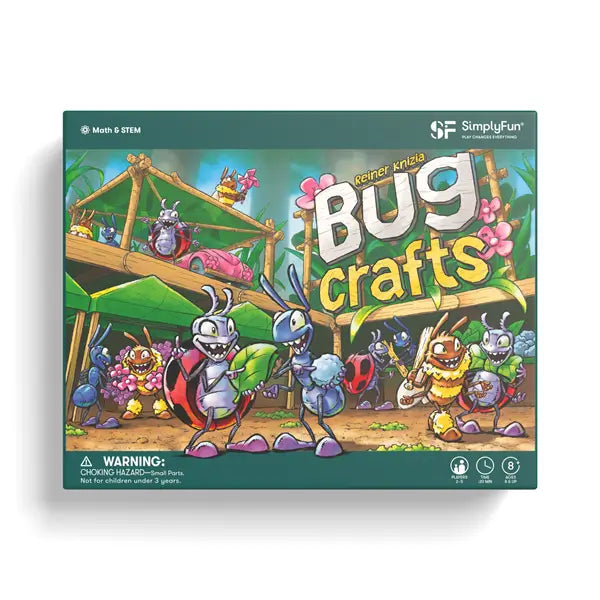




Bug Crafts
Bug Crafts

Skills: Decision Making, Planning, Resource Management
Game Includes
Game Includes
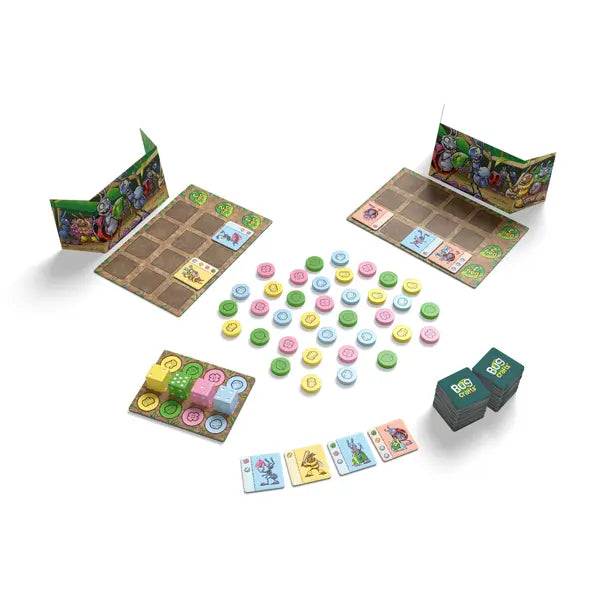
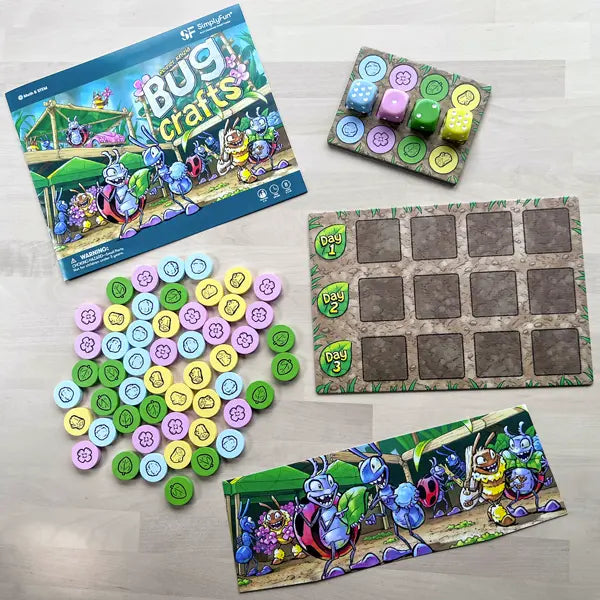
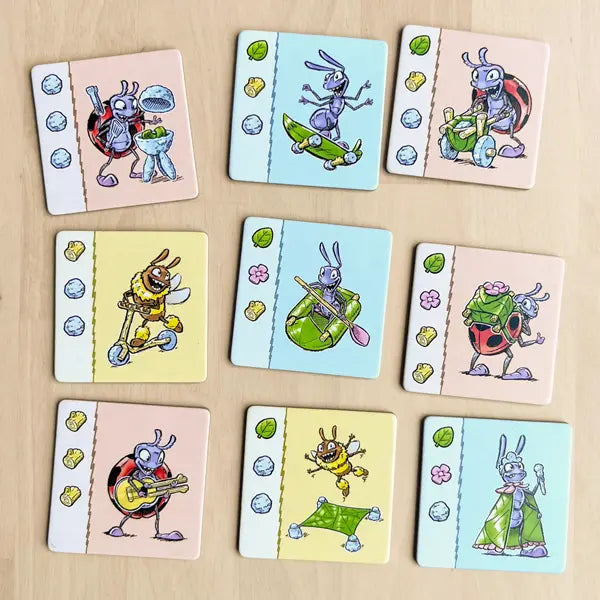
- 54 Craft Tiles
- 20 Ants [Blue]
- 18 Bees [Yellow]
- 16 Ladybugs [Red]
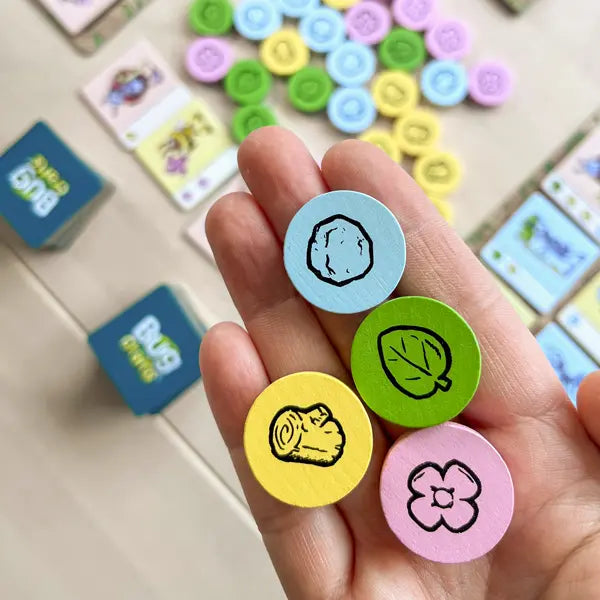
- 52 Material Tokens
- 13 in 4 different colors
- 5 Tracking Boards
- 5 Player Screens
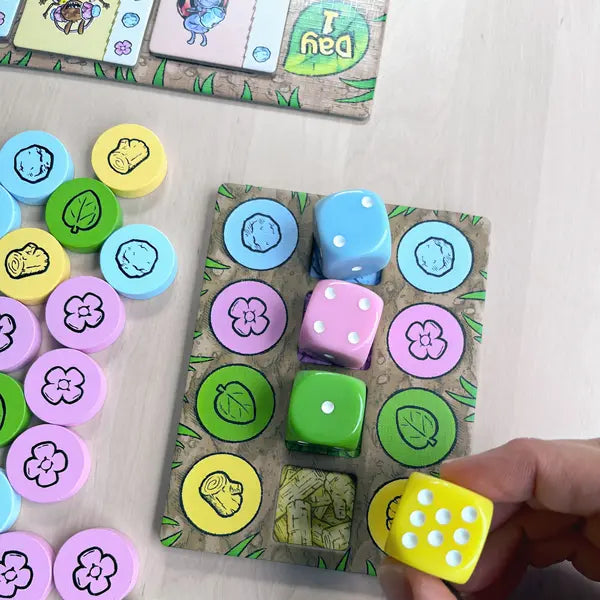
- 4 Dice
- 4 colors matching the tokens
- 1 Dice Holder
- 1 Rules Booklet




Players visit the market to collect and trade craft materials to build crafts for the thriving bug community. The player with the largest, most diverse collection of bug crafts wins!
Collapsible content
The buzzing bug market is alive with activity as players scurry to gather and trade leaves, flowers, stones, and wood. Each material helps you craft delightful creations for the bees, ladybugs, and ants of the bug community. You can play Bug Crafts with 2-5 players, ages 8 and up!
Bug Crafts is great for Decision Making. Players have opportunities to trade, build, or take in each turn. Players strategize on how to make the best trades of goods to be able to save up for the best craft before it is snatched by another player for maximum points each day.
Bug Crafts also helps develop Planning & Resource Management. Using basic math skills (including an introduction to factoring), players evaluate the market value of the materials, the number of materials saved, and the crafts available to build to make the best decision each round.
• Place the material tokens in the middle of the gameplay area. This represents the market.
• Give each player one material token of each color (four in total).
• Each player takes one screen and places it in front of themselves, hiding their material tokens from the view of other players.
• Then, each player takes a tracking board and places it in front of their screen, so other players can see it.
• Shuffle the craft tiles and place them in a face-down stack. If you wish, you may split the tiles into multiple stacks.
• Draw four tiles from the stack and place them face up next to the stack.
• The first player to name a bug goes first. Give this player the dice holder and all four dice.
Players visit the market to collect and trade craft materials to build crafts for the thriving bug community. The player with the largest, most diverse collection of bug crafts wins!
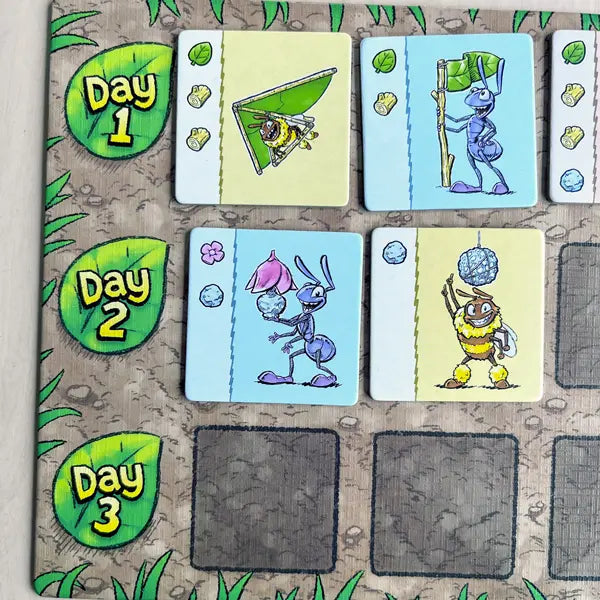
The game is played over three days. Each of the three rows of the tracking board relates to one day. After three days, there will be a scoring phase. Each day in the game consists of multiple rounds. In each round, each player will take one turn.
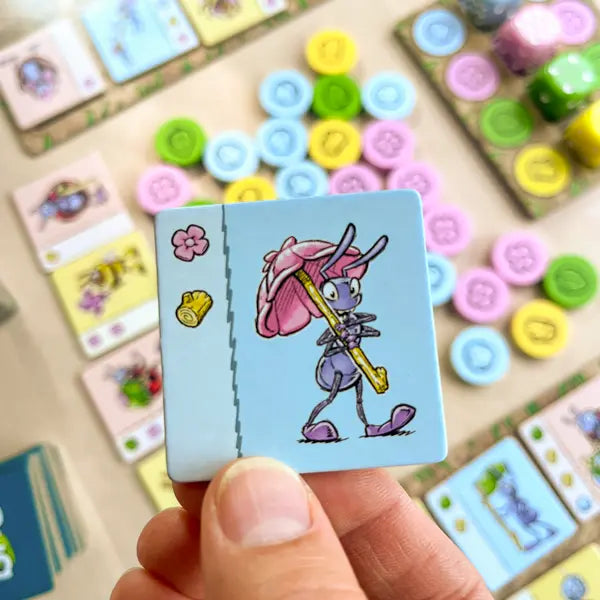
The main goal of the game is to build the crafts shown on the craft tiles. The symbols on the left side of each tile correspond to the material tokens required and how many points the tile will be worth during scoring, from one to four.
Starting a Round
The starting player begins the first round by rolling all four dice and placing them into the matching slots in the dice holder. They then place the dice holder in front of their tracking board so all players can see the dice. The dice values determine the craft material prices for this round.
Example: The starting player has rolled a 1 for sticks, a 2 for leaves, a 4 for rocks, and an 8 for flowers. This means that one flower is worth two rocks, four leaves, or eight sticks this round. Furthermore, one rock is worth two leaves or four sticks, and one leaf is worth two sticks.
On Your Turn
On your turn there are three possible actions you can take. Choose one action per turn. The three actions are:
• Trade by swapping craft materials at the market to improve or increase the material stash behind your screen.
• Build a craft by returning the material tokens depicted on one of the currently displayed craft tiles to the market to collect the craft tile.
• Take one single material token of any color.
Action 1: Trade
Trading is done by exchanging one single material token you have behind your screen with one or more tokens in the market. You can only receive tokens that have equal or lesser total value than the token you trade in.
Example: You’re trying to increase your number of tokens. The dice show a value of 8 for flowers, 4 for sticks, 2 for rocks, and only 1 for leaves. You could trade in a stick token for two rock tokens, since the value of a stick is double the value of a rock, or trade a stick token for one rock and two leaf tokens. If you have a flower token to trade in, you can collect even more, as long as the value of what you take is equal to (or less than) what you trade in.
When you make a trade, announce to the other players what materials you are trading.
Note: Sometimes a type of material will be unavailable from the market, so you may have to make a different trade than you were planning.
Action 2: Build
When you have acquired enough material tokens, you can choose to build one of the four craft tiles currently available. To do this, take the material tokens you have that match the materials depicted on the craft tile you wish to build. Place the material tokens back in the market, then take the craft tile and place it on any empty slot in the current day of your tracking board.
After placing your tile, immediately replace the craft tile you have taken with a new face-up craft tile from any stack so that there will be four craft tiles available for the next player.
Action 3: Take
If you are unable or do not want to trade tokens or build a craft, you have the option to take a single material token from the market at no cost. This is a good option if the material you’re looking for is of equal or higher value to the material you’d like to trade in.
End of Your Turn
After completing your chosen action from the three options, your turn ends. The next player in clockwise order will then take their turn, using the same dice values for the market.
End of a Round
After all players have taken one turn with the current dice values, the starting player passes the dice and dice holder to the next player clockwise. This player becomes the new starting player for the next round and play continues normally with the new starting player rolling the dice to start a new round.
Rounds continue until the day ends.
End of a Day
The end of a day is triggered as soon as one player fills all four slots of the current day on their tracking board.
When this occurs, continue playing until the round ends. This way, it may be possible for multiple players to fill all four slots. Pass the dice and dice holder to the next starting player and prepare to start a new day.
Starting a New Day
The new starting player removes all four currently available craft tiles and places them face down at the bottom of any stack. They then draw four new tiles. Next, the starting player begins a new round by rolling the dice and placing them in the dice holder. Play continues normally.
End of Game
After the end of the third day, each player scores the craft tiles they were able to build.
Craft Materials: Each material depicted on the craft tiles scores one point, so each tile will score from one to four points. Simply count up the material icons on your tiles to determine your score.
Bug Bonus: For each day that contains at least one of each type of bug (Ant, Ladybug, and Bee), score five bonus points. Add your bug bonuses to your tile score to determine your total score for the game.
After scoring all your crafts and bug bonuses, the player with the most points wins!
The more creative and clever you are, the more you’ll impress your tiny friends and become the ultimate bug artisan when you play SimplyFun’s Bug Crafts!
Core Standard*: Math
Math
- Mathematical Practice
- Make sense of problems and persevere in solving them. Grade Levels 3rd, 4th
- Attend to precision. Grade Levels 3rd, 4th
Explore
What Does Child Do To Use Skill In The Game?
On their turn, players need to look closely at various game elements, including the market, visible craft tiles, all tracking boards and their own materials token.
How Parents Can Assist Learning
Parents can encourage children to take their time looking at the craft tiles and all the tracking boards to think about what may be the best action to take that may help them now or set themselves up for success on future turns. This will discourage impulsive actions.
Learning Implications and Educator Support
Playing Bug Crafts helps children develop situational analysis, decision-making, risk assessment and perspective changing.
Encourage children to look closely at all the tracking boards to think about what other players are planning. Then examine which options you have on this turn to trade, build and/or take. This will support more systematic and reasoned exploration.
Determine
What Does Child Do To Use Skill In The Game?
On each turn, player need to determine if they will trade, build or take. Additionally, based on which action category they chose, they need to determine the exact action they take such as selecting a flower token or trading a stick token for multiple tokens of the same value cumulatively from the market.
How Parents Can Assist Learning
Parents can help children by suggesting they think about all three action options (trade, build, take) to see which are available and what is the benefit and risk of each.
Learning Implications and Educator Support
Bug Crafts involves examining the visible game area along with their hidden cache of tokes to create mental models of the consequences of different possible actions to take.
When first learning to play, players may not identify all options or focus on more immediate results of an action. As they become more proficient, children will think ahead and try to anticipate the actions of others in order to make a better scoring decision.
Compare
What Does Child Do To Use Skill In The Game?
Comparing occurs in combination with determining as players analyze different options they have prior to making a final decision of what action to take.
How Parents Can Assist Learning
As children are trying to determine which options they have, parents can help children asking the child to share how they are evaluating the different options they may have. Ask open-ended questions like, "Why do you think that option is better than another?" and "What do you think the next player might do based on the action you are considering taking?"
Learning Implications and Educator Support
Comparing in Bug Crafts helps children learn situational analysis and planning because the need to consider and compare consequences of specific action options. Optimally, their analysis would include effect on their current and future turns relative to scoring options for themselves and other players.
Ask open-ended questions like, "Why do you think that option is better than another?" and "What do you think the next player might do based on the action you are considering taking?"
Verbalizing is a good technique for strengthening the child's analytical abilities and problem-solving.
Remember
What Does Child Do To Use Skill In The Game?
Memorization is not a feature of the game. However, if a player remembers which tokens other players are collecting, that may help them predict which craft tiles those players are trying to build.
How Parents Can Assist Learning
Parents can encourage children to pay attention to and try to recall the actions of other players. This can help them more thoroughly assess what action to take on their turn.
Learning Implications and Educator Support
Educators can encourage children to pay attention to and try to recall the actions of other players. This can help them more thoroughly assess what action to take on their turn.
Predict
What Does Child Do To Use Skill In The Game?
In regular gameplay, players may try to predict which craft tiles others are trying to build. In the advanced game, predicting may become more important as players may want to prevent others from getting "column match" bonuses.
How Parents Can Assist Learning
Parents can suggest a child think about what each other player may do on their next turn. This will help them decide which action (take, trade or build) would be the best to take on their turn.
Learning Implications and Educator Support
Playing Bug Crafts helps student develop reasoning and analytical skills, risk assessment and perspective changing, all skills that can be used to make more accurate predictions of opponents' moves. Additionally, making predictions requires analysis, observation, empathy and interpretation.
Educators can suggest a child discuss what they think other players may do on their next turn. This will help the student decide which action (take, trade or build) would be the best to take on their turn.
Plan
What Does Child Do To Use Skill In The Game?
Planning is a key skill used and developed playing Bug Crafts in part because it involves all of the prior skills. Also, it incorporates strategic thinking related to optimizing scoring for yourself while limiting scoring of other players.
How Parents Can Assist Learning
To be successful in this game requires thinking about consequences beyond a player's immediate move. This type of long-term, sequential thinking is important beyond the game for activities such as building forts, making art and successfully completing schoolwork on time.
Parents can encourage a child to spend to time to think about how an action they are considering, like taking a token, would help them on a future turn and impact other players on their next turns.
The advanced version also includes some spatial reasoning as players try to align the same insects in columns to earn bonuses. When children first begin playing this version, parents may need to remind them to think about vertical connections to help the child think through where to place craft tiles on their tracking board.
Learning Implications and Educator Support
Planning is an important skill for developing strategic thinking, persistence and reaching a goal. Encourage the children to discuss the goal for the game and how the action they are considering improves their ability to attain the goal and/or inhibit other players' ability to score.
Ask open-ended questions like, "Why do you think that option is better than another?" and "What do you think the next player might do based on the action you are considering taking?"
Verbalizing is a good technique for strengthening the child's analytical abilities and problem-solving.
The advanced version also includes some spatial reasoning as players try to align the same insects in columns to earn bonuses. When children first begin playing this version, educators may need to remind them to think about vertical connections to help the child think through where to place craft tiles on their tracking board.
Experiment
What Does Child Do To Use Skill In The Game?
Bug Crafts offers many opportunities for players to experiment with different approaches such as accumulating tokens early in order to have more flexibility to build crafts later, or attempt to be first to fill all four spaces in a row on their tracking board in order to limit scoring of other players for that day.
How Parents Can Assist Learning
Discuss different strategies prior to starting the game and encourage the child to select one. Play the game and discuss. Then, play again with the child trying a different strategy. Discuss again and compare the advantages and disadvantages.
Learning Implications and Educator Support
Bug Crafts is a good game for experimenting with different strategies for an entire game, adapting strategies within a game, and trying different actions. Experimentation is an important skill for creativity, problem-solving and analysis.
Discuss different strategies prior to starting the game and encourage the child to select one. Play the game and discuss. Then, play again with the child trying a different strategy. Discuss again and compare the advantages and disadvantages. Similarly, consider
Practice
What Does Child Do To Use Skill In The Game?
Bug Crafts has regular and advanced directions and involves multiple levels of implied mastery.
Learning Implications and Educator Support
Bug Crafts is a highly strategic game with various decision-making and scoring options so that players will improve their strategic thinking, decision-making and analysis the more they play the game, similar to games like checkers to chess.
Solve
What Does Child Do To Use Skill In The Game?
Ultimately, players solve the game by adapting their strategies based on the actions of other players in order to have the best score at the end of the game, including attempting to secure bonus points.
How Parents Can Assist Learning
As the game is being learned, children may not choose the optimal action on their turn. If you see this happen a few times, ask them to explain their thinking and discuss what they might do differently next time.
Learning Implications and Educator Support
Bug Crafts involves a high degree of analysis, planning, strategy, adaptability and problem-solving.
After children have mastered the rules and understanding of different actions, they learn new information constantly during game play. This information directly effects how children make decisions and adapt strategies to ultimately solve the game.
*Data compiled from CCSSI ELA Standards, WA Science Standards, and Washington Social Studies Standards
Cognitive
Suggestions for How to Modify Play Experience
For children who cannot do addition, multiplication, and division, make Bug Crafts a matching and counting game. Children will learn to count on from one to four. Give each child a tracking board. Turn craft tiles face-down. The goal of the game is to have a bug with one more materials in each block of the day, from one to four. As their board fills, they can trade with other players for craft tiles with the needed amount of materials or another matching bug with the needed amount of materials. They can also earn points for matching bugs either horizontally or vertically. The game ends when one player completes his board. Each correctly numbered row is worth 10 points. Add one point for each vertical or horizontal matching bug.
Communication
Suggestions for How to Modify Play Experience
Bug Crafts give children an opportunity to discuss how bugs on the cards are the same or different, describe the actions or crafts depicted on the cards, and explain their numerical operations. Encourage this discussion rather than just playing the tokens and placement of craft tiles.
Modify the game to require the players to describe what is happening on their craft tile when they place one on their tracker board. This requires using descriptive and action words and sentences.
Sensorimotor
Suggestions for How to Modify Play Experience
Fine motor skills are needed to manipulate the tokens and place the craft tiles. For children with fine motor concerns, playing with a partner allows them to use their mind and have a peer do the manipulation of the game materials.
Social Emotional/Behavioral
Suggestions for How to Modify Play Experience
Bug Crafts will be challenging for children struggling with early math operations. Playing in pairs will allow children to talk over alternatives and make joint decisions about what to play.
Allow children to use pencil and paper to make marks for the different values and then add up the marks.
Vision
Suggestions for How to Modify Play Experience
Bug Crafts is not a good choice for children with low vision because the craft tiles are visually complex and, therefore, may be hard to analyze. The colors on the materials tokens and craft tiles are also in pastel colors, so may be difficult to differentiate.
Hearing
Suggestions for How to Modify Play Experience
Children who are deaf or hard-of-hearing should be able to play Bug Crafts. Have players who are trading in tokens visually demonstrate which ones they are trading, so all can see.
*Data compiled from CCSSI ELA Standards, WA Science Standards, and Washington Social Studies Standards
Autism Strengths & Interests
Short Summary of Strengths & Interests
- Using math operations (composing and decomposing numbers up to 8)
- Strategic thinking
- Decision making
Is good at matching visual items
Is This Game Appropriate? Yes
Description
Players need to match a craft tile with the corresponding materials tokens to be able to "build" the craft on their tracking board. They can earn extra points if at least one ant, bee AND ladybug tile are collected in a row on their tracking board.
Has a good memory for sensory details, including visual, touch, taste and smell
Is This Game Appropriate? Yes
Description
Visual differentiation is needed to determine the type of bug on each tile and the type of materials on each tile.
Has a good memory for words, phrases and dialouge
Is This Game Appropriate? No
Description
Players need to understand rather complex directions. Demonstration of options will be helpful. Players also need to describe what tokens they are trading for and their values, but discussion among the players is not required (though encouraged).
Has a good memory for pictures, numbers and patterns
Is This Game Appropriate? Yes
Description
Players need to remember how the values of the materials tokens can be translated into other values by using addition, multiplication, or division (e.g., a token worth 8 can be valued at 2+2+2 tokens, 4 x 2 tokens, or 8➗2=4).
Likes to put things in order or a sequence
Is This Game Appropriate? Yes
Description
Players order their cards in rows for each of 3 days. The cards selected can influence the score for the round.
Learns through visualizing or "replaying" actions in their mind
Is This Game Appropriate? Yes
Description
Players may visualize the different ways a number can be composed or decomposed to end up with a desired token amount.
Likes activities with rules, such as math and phonics
Is This Game Appropriate? Yes
Description
Simple math operations are involved.
Is very concrete and literal
Is This Game Appropriate? No
Description
Knowledge of simple math processes requires some abstract thinking. A paper and pencil may allow a play to depict options with marks on paper to make it more concrete.
Learns in small "chunks" (for example, phone numbers are 3 chunks of number xxx-xxx-xxxx that are combined together)
Is This Game Appropriate? Yes
Description
Thinking of the various ways to "chunk" a total number can help the player think of options for play.
Is good at nonverbal reasoning and logic
Is This Game Appropriate? Yes
Description
Bug Crafts is a strategy game requiring reasoning and logic. Players need to determine which option (trade, build, or take) is most beneficial for each turn.
Likes spatial problem solving
Is This Game Appropriate? No
Description
Although players do need to arrange their tiles on their tracking board, this involves nominal spatial reasoning only in the advanced version described in the instructions.
Can read well with good vocabulary, though may not fully comprehend content
Is This Game Appropriate? No
Description
No reading is required, if the directions are explained.
Likes to use and has good fine motor skill
Is This Game Appropriate? Yes
Description
Although some manipulation of game pieces is required, most players will be able to move the tiles and tokens without difficulty
Likes established routines or set ways of doing things
Is This Game Appropriate? No
Description
The values of the materials on the tiles changes with each turn. This may be confusing for some children, as they have to shift their thinking from the previous values to new values indicated on the dice.
Likes manipulating, constructing or building things
Is This Game Appropriate? No
Description
Not involved
Likes to use and has good musical abilities
Is This Game Appropriate? No
Description
Not involved
Likes to use and has good drawing skills
Is This Game Appropriate? No
Description
Not involved
Autism Special Considerations
Appears to ignore other’s communication and/or has difficulty giving eye contact to a communication partner
Is This Game Appropriate for Child with Characteristic? No
Can Child with Characteristic Play Game w/o Modification? No
Strategies for Developing Compensatory Skills:
Players do not need to have eye contact, but they need to listen to and comprehend the complex instructions for the game. They also need to pay attention to each player's choice for play on their turn, to ensure they are doing trades for the right values and to enable them to think strategically about their next move.
Has difficulty understanding complex verbal directions
Is This Game Appropriate for Child with Characteristic? No
Can Child with Characteristic Play Game w/o Modification? No
Strategies for Developing Compensatory Skills:
The instructions for Bug Crafts are complex, as each player has 3 options for play on each turn (trade, build, or take). Players need to understand when each might be advantages, which may take demonstration.
Uses vocabulary inaccurately or demonstrates echolalia (repeating another’s speech)
Is This Game Appropriate for Child with Characteristic? Yes
Can Child with Characteristic Play Game w/o Modification? Yes
Strategies for Developing Compensatory Skills:
As long as the child understands the game echolalia should not prohibit their playing Bug Crafts.
Gets stuck repeating a verbal topic or physical actions and/or has difficulty attending to others’ actions or topic.
Is This Game Appropriate for Child with Characteristic? No
Can Child with Characteristic Play Game w/o Modification? No
Strategies for Developing Compensatory Skills:
Bug Crafts requires the player to focus on what they and other players are doing. Diversion to other topics may inhibit their own or others' concentration.
Has difficulty producing speech/communication
Is This Game Appropriate for Child with Characteristic? Yes
Can Child with Characteristic Play Game w/o Modification? Yes
Strategies for Developing Compensatory Skills:
Players do not need to talk, but if they are trading or building, they need to demonstrate their thinking with the tokens and/or tiles.
Has difficulty sequencing multi-step actions and/or doing complex abstract tasks
Is This Game Appropriate for Child with Characteristic? No
Can Child with Characteristic Play Game w/o Modification? No
Strategies for Developing Compensatory Skills:
There are multiple steps in each players turn such as throwing the dice, arranging the dice to match colors and values, and deciding which option to do (e.g., trade, build, or take). Considering which option is best requires abstract thinking.
Demonstrates difficulty initiating and maintaining social interactions
Is This Game Appropriate for Child with Characteristic? Yes
Can Child with Characteristic Play Game w/o Modification? Yes
Strategies for Developing Compensatory Skills:
Thinking, rather than social interaction, is the goal of Bug Crafts. Children can play without talking, if they can take turns.
Acts out or demonstrates avoidance behaviors when frustrated, overwhelmed, or needs more sensory input.
Is This Game Appropriate for Child with Characteristic? No
Can Child with Characteristic Play Game w/o Modification? No
Strategies for Developing Compensatory Skills:
Bug Crafts requires the player to focus on what they and other players are doing. Distracting behaviors will interfere with the attention of all players in the game.
Has short attention span for non-preferred activities
Is This Game Appropriate for Child with Characteristic? No
Can Child with Characteristic Play Game w/o Modification? No
Strategies for Developing Compensatory Skills:
Unless math and reasoning are preferred activities, Bug Crafts may be too demanding of the child's focus of attention.
Needs sameness or consistent routines and/or has difficulty with transitions from one activity to another
Is This Game Appropriate for Child with Characteristic? No
Can Child with Characteristic Play Game w/o Modification? No
Strategies for Developing Compensatory Skills:
With each round of play, the values of the materials change, and players need to shift their thinking to the fact that the previous material values are now different, and, consequently, their play options may need to change.
Has difficulty understanding others' feelings, intentions, and the reasons for others' actions.
Is This Game Appropriate for Child with Characteristic? Yes
Can Child with Characteristic Play Game w/o Modification? No
Strategies for Developing Compensatory Skills:
Bug Crafts can be played without being concerned about others' feelings, but players do need to take into consideration what others' may be thinking in relation to strategy. Players can help point out what is happening with other players boards to help bring attention to others' intentions.
*Data compiled from CCSSI ELA Standards, WA Science Standards, and Washington Social Studies Standards
Extra Ways to Play the Game
See 'Try This' section in the rules booklet.
Materials Needed
Developmental Benefits
*Data compiled from CCSSI ELA Standards, WA Science Standards, and Washington Social Studies Standards
Game Details
- 54 Craft Tiles
- 20 Ants [Blue]
- 18 Bees [Yellow]
- 16 Ladybugs [Red]
- 52 Material Tokens
- 13 in 4 different colors
- 5 Tracking Boards
- 5 Player Screens
- 4 Dice
- 4 colors matching the tokens
- 1 Dice Holder
- 1 Rules Booklet
- Choosing a selection results in a full page refresh.
- Opens in a new window.