
-
A Spatial Reasoning Skills Game

-

-

-

-

-

-

-

-

-

-


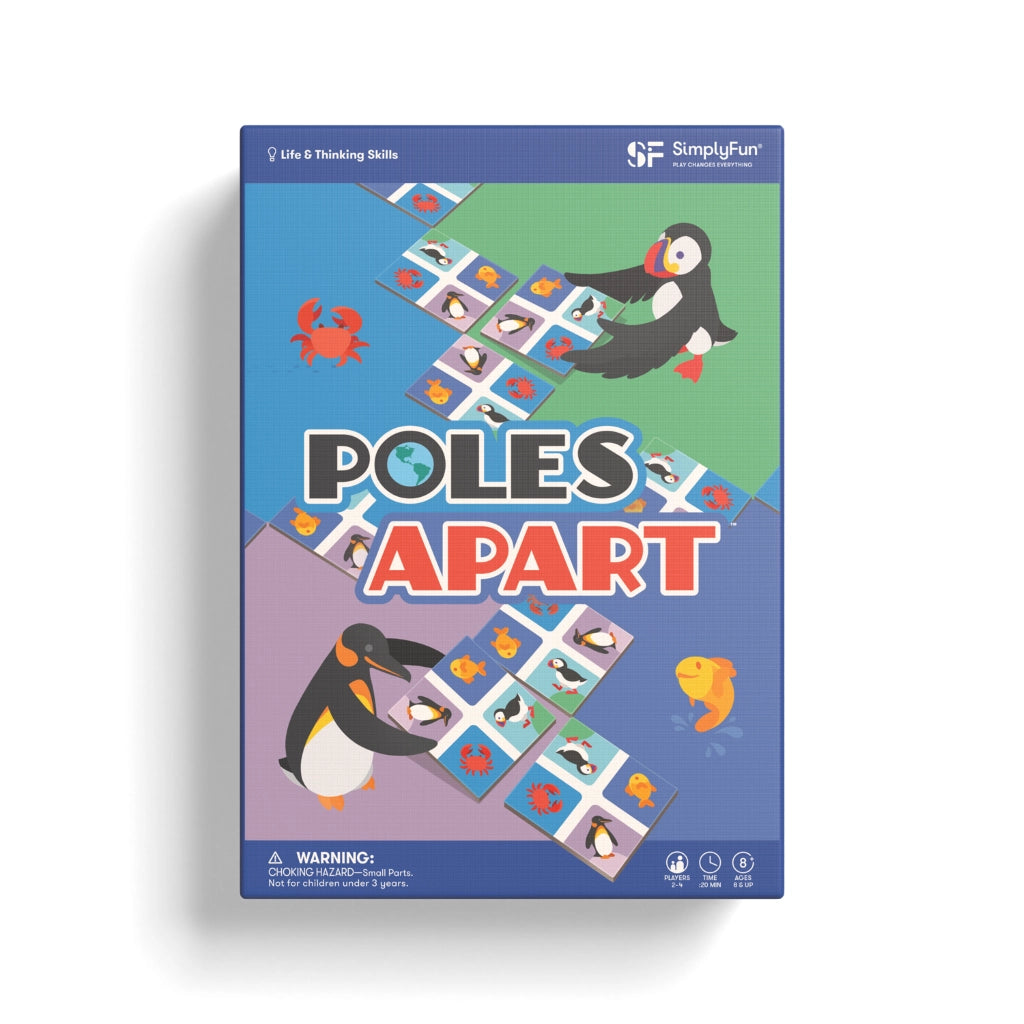
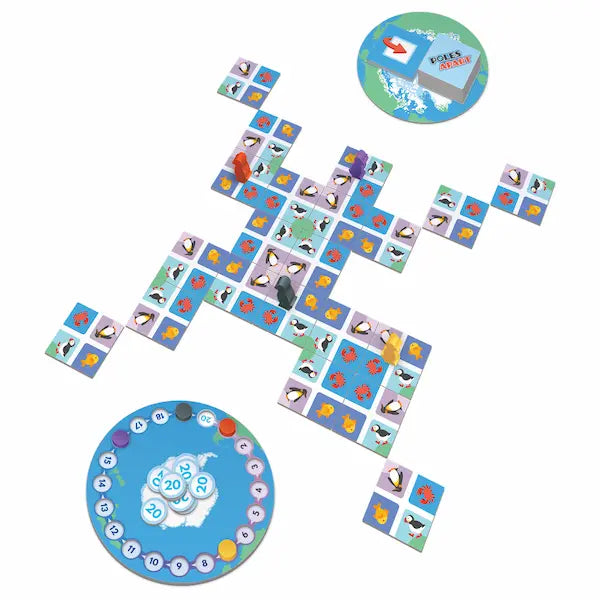
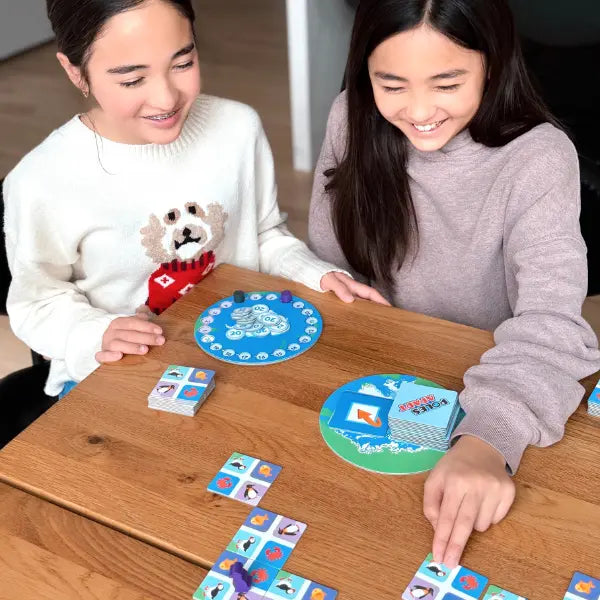
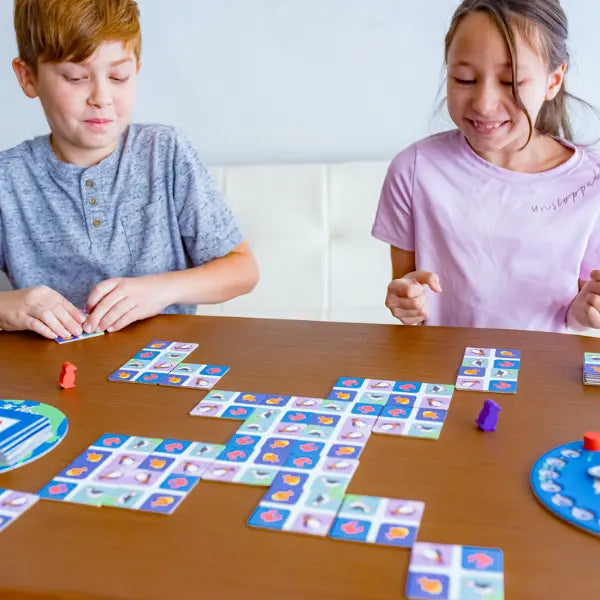




Poles Apart
Poles Apart

Skills: Spatial Reasoning, Geometry
Game Includes
Game Includes
- 36 Animal Tiles
- 16 Direction Cards
- 1 Card Tracker
- 1 Score Tracker
- 16 20-point Tokens
- 4 Score Pawns
- 4 Bird Pawns
- 1 Rules Booklet


Collapsible content
You can play Poles Apart with 2-4 players, ages 8 and up!
Poles Apart helps you with Spatial Reasoning by looking over the entire play area for a place with the most matches for your tile while visualizing what the card will look like after being flipped, in its final position
Players also touch on geometry by learning the basics of rigid motions (or isometry)—a geometric reflection in which a transformation does not change the size or shape of a figure. The geometric reflections represented over vertical, horizontal, and slanted lines relate to the X axis, Y axis, Y=X and Y=–X in formal geometry.
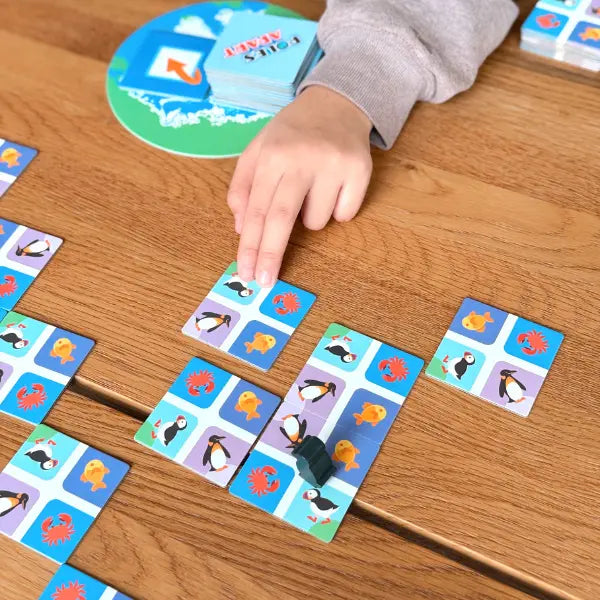
Take 13 tiles at random and lay them out corner to corner, creating a seven-by-seven X on the table. This is the play area.
- Divide the remaining tiles into as many equal stacks as there are players in the game. Place a stack in front of each player. Return any spare tiles to the box.
- Give each player a bird pawn and matching circular score pawn.
- Place the score tracker near the play area.
- Players place their score pawns near the “1” on the score tracker.
- Place the 20-point tokens on Antarctica in the middle of the score tracker.
- Shuffle the direction cards and set them in a deck on the card tracker.
Players try to place their tiles strategically so that when a tile is flipped over, it matches as many animals as possible without ever having the puffins and penguins touch.
To start the game, a player reveals the first direction card from the deck.
Direction Cards
The direction card shows which way the player’s placed tiles will be flipping after they are all placed this round. There are different types of direction cards: yellow arrows point diagonally and red arrows point orthogonally (meaning: side to side or top to bottom.)
The way the arrow is pointing is the direction that all players will flip at the end of the round. There are many possible directions: bottom to top, left to right, and even diagonally.
Keep in mind, when you flip your tiles, that they stay in place. Tiles do not move locations or jump.
Placing Tiles
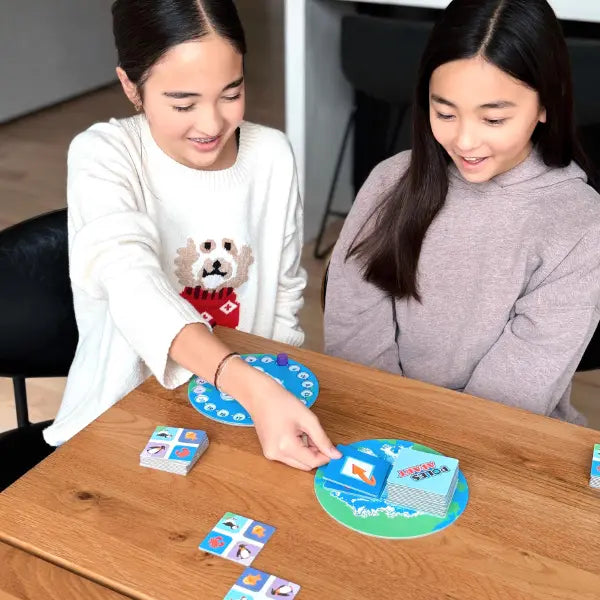
Once everyone knows the direction for the round, each player takes their turn simultaneously.
Looking at the top tile on their stack, each player tries to work out where in the play area they can place their tile to make the most animal matches after the tiles flip. Remember, matches made before player tiles flip do not earn points. It is only after all player-placed tiles flip that players will earn points.
The tile on top of your stack is the tile you place this round. Keep that tile on your stack and keep your stack on the table. You may spin your tile stack before you place your tile, but you may not lift or flip it over before placing it.
Note: Diagonal, or corner to corner, does not count as directly touching
When placed, your tile must directly touch at least one other tile, edge to edge with the white gutters of the tiles aligned, as shown in the example.
After you have placed your tile, put your bird pawn on top of the tile to show that your decision is final, and to remind everyone which tile is yours.
You cannot move your tile again once the bird pawn is placed and you cannot place your tile next to another player’s tile marked with a bird pawn. You must go back and move your tile to another valid location.
Note: Diagonal, or corner to corner, does not count as directly touching.
When everyone has placed their tile and bird pawn, players carefully flip their tile in the direction indicated on the direction card for this round and place their pawns back on the respective tiles.
Scoring Points
After flipping everyone’s tiles, it is time to earn points. For each group of matching animals you create with your tile, you earn 1 point per animal in the group. For example, a pair of fish would earn 2 points, while 3 fish all touching would earn three points. Remember, it is only the position of the animals after your tile has been flipped that counts.
If, after the flip, you end up with a penguin next to a puffin on your tile, you score zero points for the round. Note: It is okay if your tile placement has a penguin and puffin directly touching before the flip. It is only after the flip that matters.
Track your scores by moving each player’s score pawn on the score tracker as they earn points.
When a player scores over 20 points, they take a 20-point token from Antarctica and continue to loop around the tracker.
Once scoring is complete, players remove their bird pawns from their tiles.
To start the next round, a player reveals the next direction card from the deck, and the game continues.
When all the tiles in players’ stacks have been used and no one has any tiles left to place, the game is over.
The player with the most points is the winner! If players tie, then they share the victory.
SimplyFun’s Poles Apart challenges players to visualize flips and reflections, building spatial reasoning skills through fun geometric play. Keep the animals happy and the puffins and penguins Poles Apart!
Core Standard*: Math
Math
- Geometry
- Reason with shapes and their attributes. : Grade Level 3rd
Explore
What Does Child Do To Use Skill In The Game?
On their turn, players need to look closely at the play area to see where they can play their animal tile to maximize points and avoid a penguin ending up next to a puffin which voids all their points for that turn.
How Parents Can Assist Learning
When first learning the game, children may not remember that scoring occurs after their cards are flipped. It may help to remind them that they can rotate their cards and to think about what will happen when they flip their cards for scoring. To guide analytical thinking, spatial reasoning and patience, you can ask questions like, "What direction will you flip your card?" and "Where will the (name any animal on their card) be located after you flip your card?"
Learning Implications and Educator Support
Poles Apart involves a lot of spatial visualization, spatial reasoning and analysis. In the game, each turn involves using and building the following skills simultaneously -- exploring, comparing, determining and planning -- in order to chose what tile to play and how to flip it to score the most points. To guide analytical thinking, spatial reasoning and patience, you can ask questions like, "What direction will you flip your card?" and "Where will the (name any animal on their card) be located after you flip your card?"
Determine
What Does Child Do To Use Skill In The Game?
Poles Apart involves a high degree of determining as players examine the play area to decide which is the best placement of their card to score points after it is flipped.
How Parents Can Assist Learning
If you notice that a child is having difficulty visualizing the location of animals after a card is flipped, allow all players to flip their cards according to the direction card while exploring placement options. Once all players are proficient in basic visualization, play according to the rules.
Learning Implications and Educator Support
Determining where to place an animal card builds a child's analytical, logic and spatial reasoning skills. When first learning to play, allow all players to flip their cards according to the direction card while exploring placement options. After a few rounds, play according to the rules.
Compare
What Does Child Do To Use Skill In The Game?
Poles Apart requires a high level of comparing because there may be dozens of options for playing an animal card during a turn.
How Parents Can Assist Learning
To help keep track of scoring options, give children small pieces of paper. Let them write the score on a piece and place it where they can place their animal card. After reviewing all plausible options, they can select the highest scoring option by looking at their pieces of paper.
Learning Implications and Educator Support
Poles Apart involves examining the play area and creating mental models of the consequences of playing and flipping their animal card. Making and comparing mental models is an advanced, complex cognitive skill that supports learning spatial relations, pattern recognition and creative problem solving. To help children learn these skills, ask them to describe aloud the different sequence of placing and flipping their animal card they can make and the potential consequences for each.
Predict
What Does Child Do To Use Skill In The Game?
Poles Apart involves a little predicting because players need to anticipate accurately what their animal card will look like when flipped over.
How Parents Can Assist Learning
If children are having a hard time predicting the orientation of their animal cards after flipping, allow all players to flip their cards according to the direction card while exploring placement options. Once all players are proficient in basic visualization, play according to the rules.
Learning Implications and Educator Support
Like games from checkers to chess, Poles Apart requires children to used spatial reasoning and sequencing skills to predict what will happen if they place and flip an animal card in a particular location. Educators may want to allow children to not just hold and rotate their animal card over different locations, but also let them flip the card according to the direction card to see what will occur. Ask them to predict what the orientation of the card will be prior to flipping so you can discuss the results versus their prediction.
Plan
What Does Child Do To Use Skill In The Game?
In Poles Apart, planning is intertwined with predicting, exploring, determining and comparing. Essentially, as a child uses all those skills to identify and evaluate where to place their animal card, they are planning the action to take on their turn. They may need to adjust their plan if another player places a card in the spot the child was going to place their card.
How Parents Can Assist Learning
If children are having a hard time predicting the orientation of their animal cards after flipping, allow all players to flip their cards according to the direction card while exploring placement options. Once all players are proficient in basic visualization, play according to the rules.
Learning Implications and Educator Support
Like games from checkers to chess, Poles Apart requires children to used spatial reasoning and sequencing skills to predict what will happen if they place and flip an animal card in a particular location. Educators may want to allow children to not just hold and rotate their animal card over different locations, but also let them flip the card according to the direction card to see what will occur. Ask them to predict what the orientation of the card will be prior to flipping so you can discuss the results versus their prediction.
Practice
What Does Child Do To Use Skill In The Game?
Playing Poles Apart is a good way for children to practice and improve their spatial reasoning skills as they become more effective in mental modeling of cards being flipped.
How Parents Can Assist Learning
Parent support is not required. However, leaving the game out on a table or boxed up in a visible location may prompt the child to practice it on their own or invite you to play along.
Learning Implications and Educator Support
Educator support is not required, however, you may choose to have children play Poles Apart repeatedly for skill development.
Solve
What Does Child Do To Use Skill In The Game?
In Poles Apart, determining and solving are equivalent since deciding where to place an animal card solves what action to take on your turn. Even though the play area changes as more animal cards are placed, the process and variables for making decisions remains consistent.
How Parents Can Assist Learning
If you notice that a child is having difficulty visualizing the location of animals after a card is flipped, allow all players to flip their cards according to the direction card while exploring placement options. Once all players are proficient in basic visualization, play according to the rules.
Learning Implications and Educator Support
Determining where to place an animal card builds a child's analytical, logic and spatial reasoning skills. When first learning to play, allow all players to flip their cards according to the direction card while exploring placement options. After a few rounds, play according to the rules.
*Data compiled from CCSSI ELA Standards, WA Science Standards, and Washington Social Studies Standards
Cognitive
Suggestions for How to Modify Play Experience
Players with cognitive challenges may struggle to visualize what the cards will look like when flipped. Play without the direction cards to make the game easier for them.
Introduce a simplified version of the game, first matching one picture on a card to the cards on the play area, then trying to match two or three. If this is successful, introduce the direction cards that flip side-to-side or top-to-bottom. Introduce the diagonal direction cards last.
Let the child flip the card before placement. This will help the child learn how changing the position of the card changes the location of the pictures on the card.
Communication
Suggestions for How to Modify Play Experience
No modifications should be needed for players who have language delays or disorders. Talking is not required to play, but players can be encouraged to discuss their card placements and count their points aloud.
Sensorimotor
Suggestions for How to Modify Play Experience
Placement of the cards requires precision, so children with fine motor concerns may struggle with placement. Playing with a partner may allow the child to contribute to placement decisions, but not require the need to place the cards themselves.
Social Emotional/Behavioral
Suggestions for How to Modify Play Experience
Some children may struggle with the requirement to visualize what the cards will look like when flipped in various directions. Consequently, they may find the game frustrating. Play without the direction cards to reduce stress.
Allow the players to flip the cards before placing them on the board. This will help the child learn how changing the position of the card changes the location of the pictures on the card.
Vision
Suggestions for How to Modify Play Experience
Players with low vision may have difficulty seeing the small pictures on the cards. The game is not recommended for them.
Hearing
Suggestions for How to Modify Play Experience
No modifications should be needed for players who are deaf or hard of hearing.
*Data compiled from CCSSI ELA Standards, WA Science Standards, and Washington Social Studies Standards
Autism Strengths & Interests
Short Summary of Strengths & Interests
- Matching
- Spatial reasoning
- Mental manipulation
Is good at matching visual items
Is This Game Appropriate? Yes
Description
Poles Apart is a matching game. Players need to match as many of the four pictures on the card to the cards on the play area. If the player has difficulty with the visualization of results after flipping the direction cards, the direction cards can be omitted.
Has a good memory for sensory details, including visual, touch, taste and smell
Is This Game Appropriate? No
Description
No sensory exploration, other than vision, is required in the game.
Has a good memory for words, phrases and dialouge
Is This Game Appropriate? No
Description
No memory for words, phrases, or dialogue is needed to play Poles Apart.
Has a good memory for pictures, numbers and patterns
Is This Game Appropriate? Yes
Description
Memory for pictures is important in Poles Apart. Players need to think about where each of four pictures will be located when the card is flipped in a specific direction.
Likes to put things in order or a sequence
Is This Game Appropriate? No
Description
While there is a two-step sequence for each turn, the game is primarily about matching.
Learns through visualizing or "replaying" actions in their mind
Is This Game Appropriate? Yes
Description
Visualizing is a critical skill in Poles Apart. Players need to visualize where the four pictures on a card will be located when the card is flipped in a specific direction
Likes activities with rules, such as math and phonics
Is This Game Appropriate? No
Description
Players need to understand the rules related to spatial rotation.
Is very concrete and literal
Is This Game Appropriate? No
Description
The visualization required is abstract, while the matching is a concrete process.
Learns in small "chunks" (for example, phone numbers are 3 chunks of number xxx-xxx-xxxx that are combined together)
Is This Game Appropriate? No
Description
No "chunking" is needed or helpful.
Is good at nonverbal reasoning and logic
Is This Game Appropriate? Yes
Description
Reasoning is required to determine where pictures will be located when the card is flipped.
Likes spatial problem solving
Is This Game Appropriate? Yes
Description
Spatial reasoning and problem-solving is the core activity in Poles Apart. If children enjoy this type of activity, they make love playing the game!
Can read well with good vocabulary, though may not fully comprehend content
Is This Game Appropriate? No
Description
Reading and vocabulary are not required.
Likes to use and has good fine motor skill
Is This Game Appropriate? Yes
Description
The game involves flipping cards, therefore, players will use their fine motor skills during gameplay. However, it is not primarily a fine motor activity like building blocks or making a puzzle.
Likes established routines or set ways of doing things
Is This Game Appropriate? No
Description
This game is not appropriate
Likes manipulating, constructing or building things
Is This Game Appropriate? Yes
Description
The game involves flipping cards, therefore, players will use their fine motor skills during gameplay. However, it is not primarily a fine motor activity like building blocks or making a puzzle.
Likes to use and has good musical abilities
Is This Game Appropriate? No
Description
This game is not appropriate
Likes to use and has good drawing skills
Is This Game Appropriate? No
Description
This game is not appropriate
Autism Special Considerations
Appears to ignore other’s communication and/or has difficulty giving eye contact to a communication partner
Is This Game Appropriate for Child with Characteristic? Yes
Can Child with Characteristic Play Game w/o Modification? Yes
Strategies for Developing Compensatory Skills:
Players do not need to have eye contact with other players to play Poles Apart.
Has difficulty understanding complex verbal directions
Is This Game Appropriate for Child with Characteristic? Yes
Can Child with Characteristic Play Game w/o Modification? No
Strategies for Developing Compensatory Skills:
The verbal directions are complex. However, with support from caregiver or other players, a child can learn the game play by watching several demonstrations with the game cards and direction cards.
Uses vocabulary inaccurately or demonstrates echolalia (repeating another’s speech)
Is This Game Appropriate for Child with Characteristic? Yes
Can Child with Characteristic Play Game w/o Modification? Yes
Strategies for Developing Compensatory Skills:
Echolalia should not interfere with game play.
Gets stuck repeating a verbal topic or physical actions and/or has difficulty attending to others’ actions or topic.
Is This Game Appropriate for Child with Characteristic? Yes
Can Child with Characteristic Play Game w/o Modification? Yes
Strategies for Developing Compensatory Skills:
Unless the extraneous talking or actions are excessive, they should not interfere with game play.
Has difficulty producing speech/communication
Is This Game Appropriate for Child with Characteristic? Yes
Can Child with Characteristic Play Game w/o Modification? Yes
Strategies for Developing Compensatory Skills:
Language is not needed to play Poles Apart.
Has difficulty sequencing multi-step actions and/or doing complex abstract tasks
Is This Game Appropriate for Child with Characteristic? No
Can Child with Characteristic Play Game w/o Modification? No
Strategies for Developing Compensatory Skills:
Poles Apart requires visualizing how the location of the pictures on the cards will change when the card in flipped in a specific direction. This is an abstract process. If this is problematic for the player, the game can eliminate the direction cards. This modification will make the game more concrete by just requiring simple matching.
Demonstrates difficulty initiating and maintaining social interactions
Is This Game Appropriate for Child with Characteristic? Yes
Can Child with Characteristic Play Game w/o Modification? Yes
Strategies for Developing Compensatory Skills:
Poles Apart can be played without verbal or physical interaction, but discussion should be encouraged.
Acts out or demonstrates avoidance behaviors when frustrated, overwhelmed, or needs more sensory input.
Is This Game Appropriate for Child with Characteristic? Yes
Can Child with Characteristic Play Game w/o Modification? No
Strategies for Developing Compensatory Skills:
If the player is overwhelmed by the abstract aspect of the game, simplify the game by first matching one picture on a card to the cards on the play area, then trying to match two or three. If this is successful, introduce the direction cards that flip side-to-side or top-to-bottom. Introduce the diagonal direction cards last.
Has short attention span for non-preferred activities
Is This Game Appropriate for Child with Characteristic? Yes
Can Child with Characteristic Play Game w/o Modification? No
Strategies for Developing Compensatory Skills:
Many children with autism enjoy games with spatial reasoning and matching. Poles Apart may be a good game for this child. On the other hand, some children with autism may be overwhelmed with the abstract reasoning required. For these children, omit the direction cards.
Needs sameness or consistent routines and/or has difficulty with transitions from one activity to another
Is This Game Appropriate for Child with Characteristic? Yes
Can Child with Characteristic Play Game w/o Modification? No
Strategies for Developing Compensatory Skills:
Introduce a simplified version of the game, first matching one picture on a card to the cards on the play area, then trying to match two or three. If this is successful, introduce the direction cards that flip side-to-side or top-to-bottom. Introduce the diagonal direction cards last.
Has difficulty understanding others' feelings, intentions, and the reasons for others' actions.
Is This Game Appropriate for Child with Characteristic? Yes
Can Child with Characteristic Play Game w/o Modification? Yes
Strategies for Developing Compensatory Skills:
Does not need to understand others feelings or intentions to play Poles Apart.
*Data compiled from CCSSI ELA Standards, WA Science Standards, and Washington Social Studies Standards
Extra Ways to Play the Game
To make game easier when first learning or for children with cognitive concerns, allow players to not only rotate but also flip their animal cards when examining and evaluating where they might place the cards for maximum points and/or avoiding penguin to puffin mismatches.
Materials Needed
None
Developmental Benefits
Creating mental models of flipping animal cards according to the direction cards and the subsequent consequences involves advanced spatial reasoning and planning skills. Allowing children to flip the animal cards as part of their evaluation process helps them develop the mental modeling skills required to do construct the flipping and consequences entirely in their mind.
Extra Ways to Play the Game
Rather than everyone playing simultaneously during a round, play the game with sequential turn taking. If this makes the game too slow, add a timer. Give each player 1 minute to play their animal card. Adjust the amount of time based on mutual agreement of the players, if desired.
Materials Needed
Possibly need to add a timer.
Developmental Benefits
This way to play may make it easier for children to focus, analyze and make the best choice because they do not need to try to race to place their animal card before another player. Adding the timer is primarily about ensuring the game moves at a pace that is good for all players, and can add a dimension of excitement built into many other great games.
*Data compiled from CCSSI ELA Standards, WA Science Standards, and Washington Social Studies Standards
Game Details
- 36 Animal Tiles
- 16 Direction Cards
- 1 Card Tracker
- 1 Score Tracker
- 16 20-point Tokens
- 4 Score Pawns
- 4 Bird Pawns
- 1 Rules Booklet
- Choosing a selection results in a full page refresh.
- Opens in a new window.