
-
A Cooperation Skills Game

-

-

-

-

-

-

-


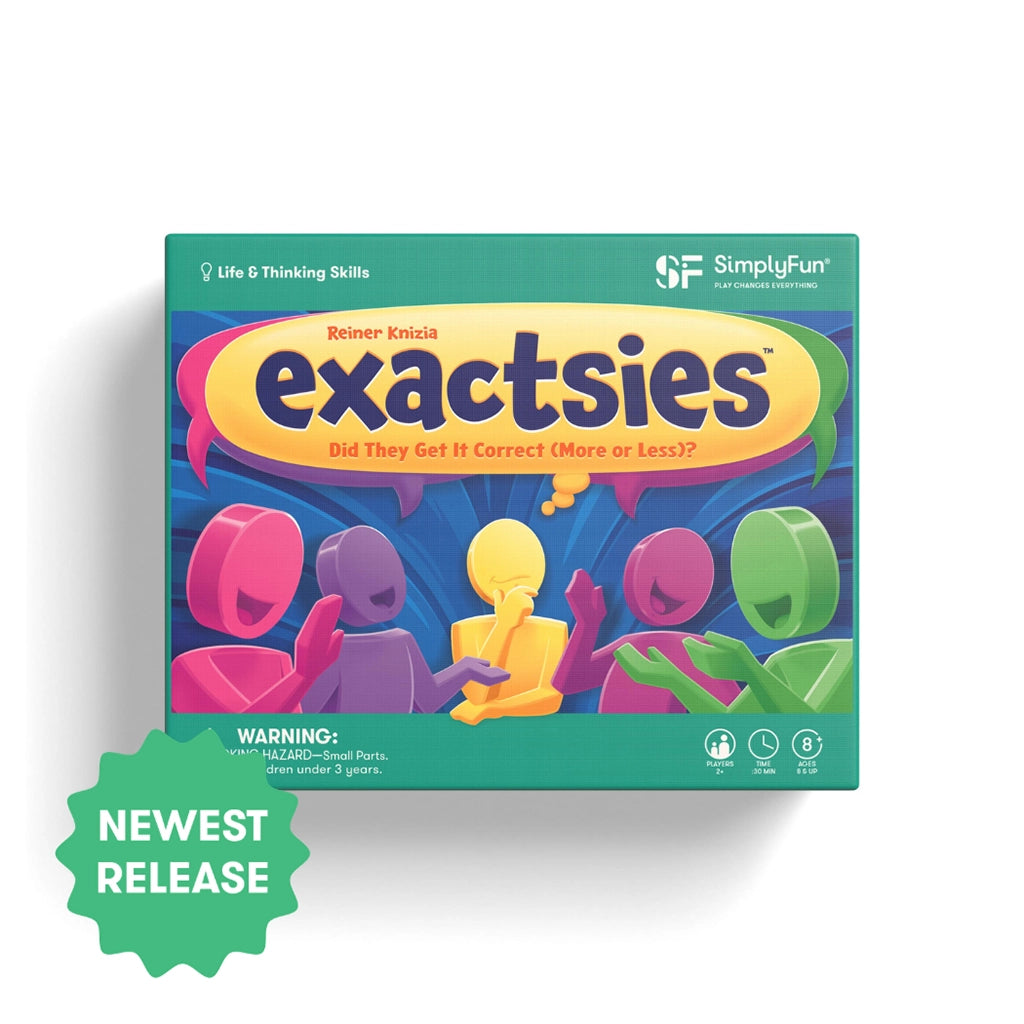



exactsies
exactsies

With wild trivia and little-known facts, use what you know to figure out what you don’t! Team up to mind-meld your knowledge and put cooperation, logic, deduction and problem solving to the test. Debate your best guess and answer together. Will it be over, under, or perfectly exactsies!?
Skills: Cooperation, Problem Solving
Game Includes
Game Includes
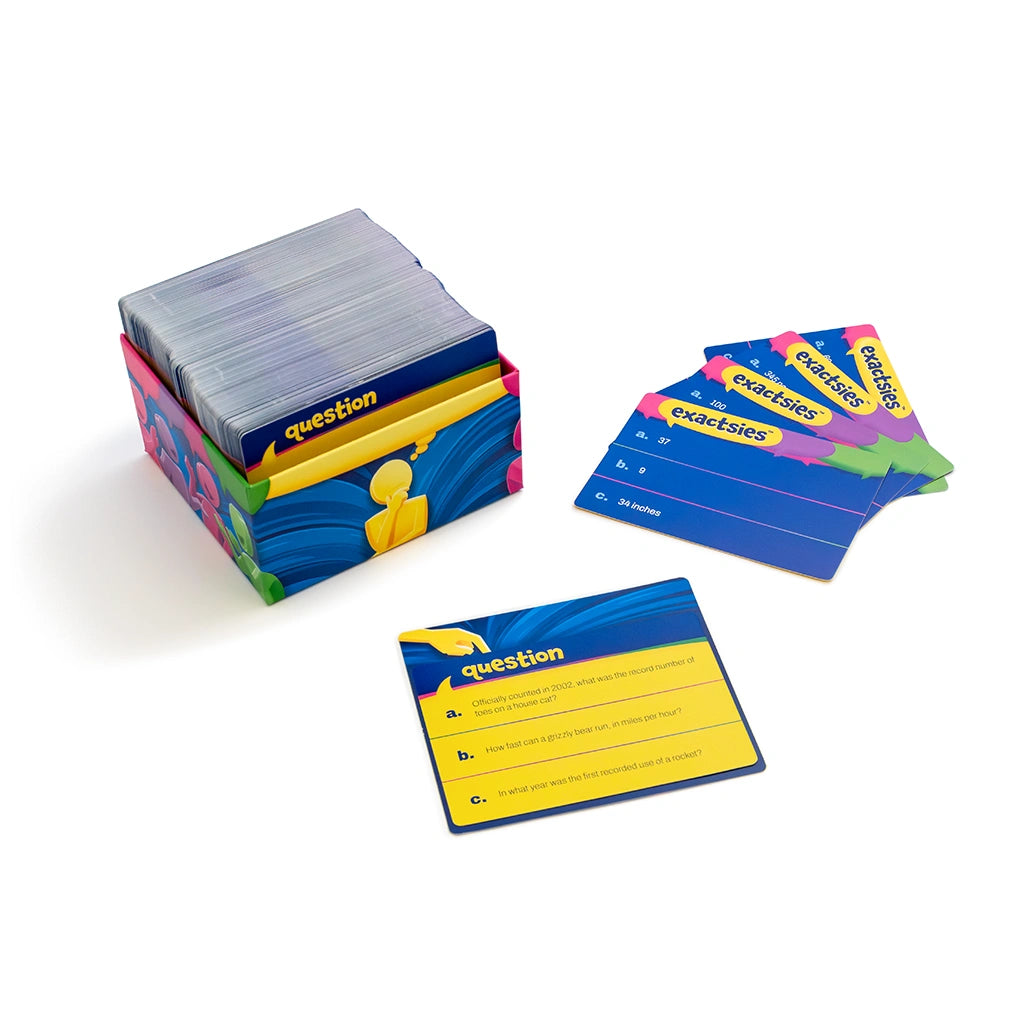
- 300 Question Cards
- 1 Card Screen
- 1 Card Box
- 1 Rules Booklet


Collapsible content
You can play Exactsies with two or more players, ages eight and up.
COOPERATION
Players work collaboratively, which practices good listening and verbal communication as they work to agree on a single answer while building confidence in making thoughtful decisions.
PROBLEM-SOLVING
Working as a team strengthens critical thinking and problem-solving skills. Players use logic and deduction by analyzing clues, comparing knowledge, and reasoning through possible answers.
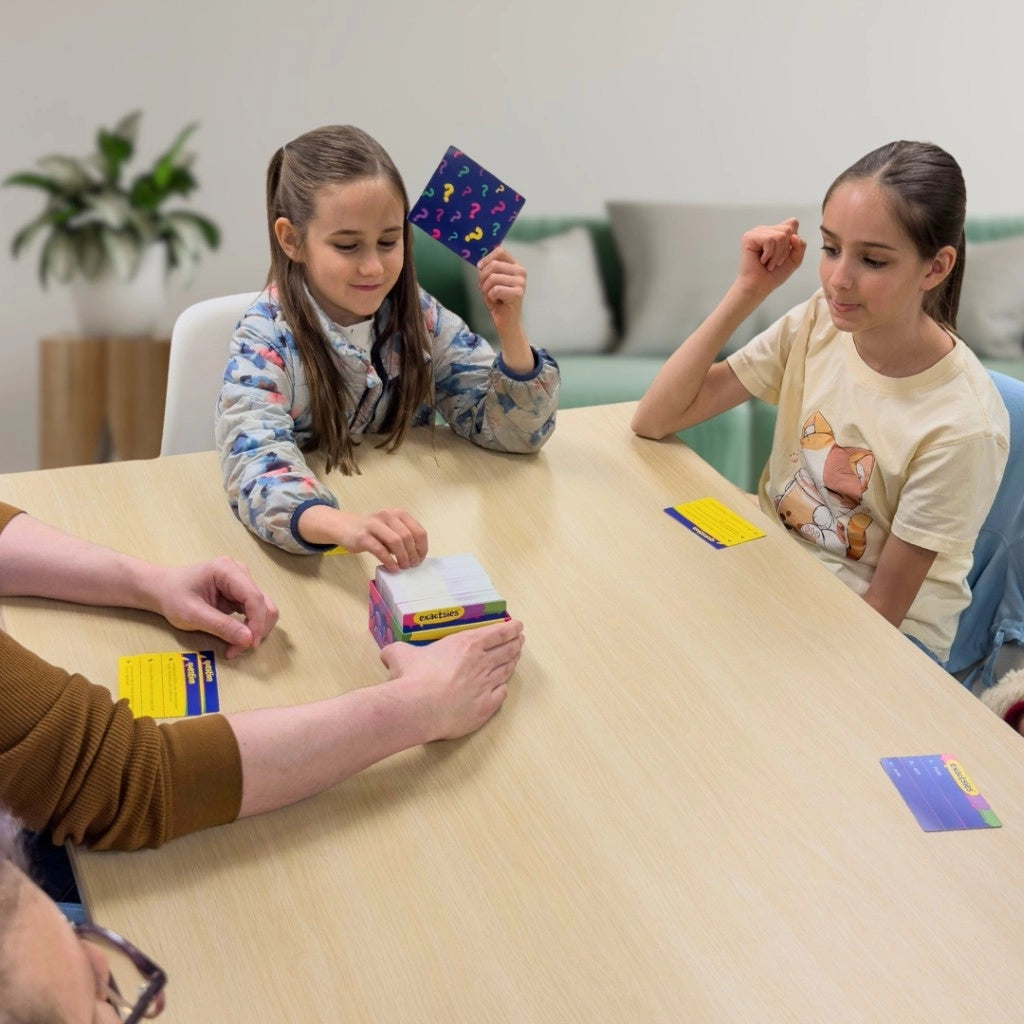
Place the card box in the center of the play area within reach of all players. The person who most recently shared some trivia will be the first reader. Pass this player the card screen. Take turns being the reader and let the group collectively guess the answer.
Gather cards by correctly guessing whether the true answer is over, under, or Exactsies, exactly matching the guess. The player with the most cards wins.
STEP ONE: ASK A QUESTION
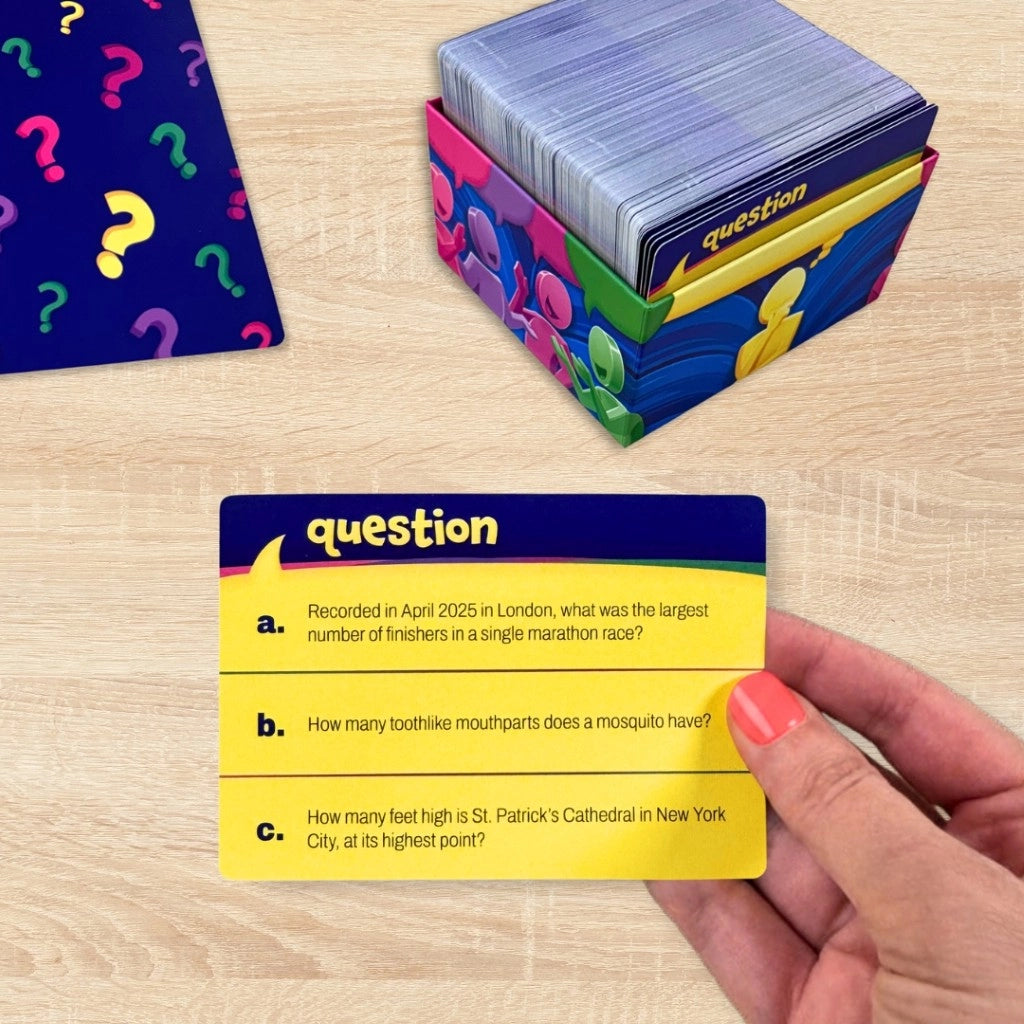
The reader starts the game by drawing a question card from the front of the card box. The front is the side showing the question header on the card. Since the answers are on the back of each card, the reader should place the card screen behind the card to keep the answers hidden. Even the reader is not allowed to look at the answers yet. Each card has three questions. The reader chooses any one of the questions and reads it aloud to all players.
STEP TWO: DISCUSS
Next, all players other than the reader collectively discuss among themselves to try to identify a possible answer. The group doesn't have to find the right answer, they just need to agree on one guess. In a two-player game, the player who isn't the reader decides on their own.
Note: every answer is numerical. It could be a measurement, a year, or something else, but it will always be shown numerically.
STEP THREE: DECIDE
Once the group has arrived at one common answer, it's up to the reader to decide what they think of the group's guess. Then, without turning the card over, they announce whether they believe that the true answer is either over (a higher number, a later date, et cetera), under (a lower number, an earlier date, et cetera), or Exactsies, exactly matching the group's guess.
Once the reader has announced their choice, they turn over the card and read the true answer aloud. Answers are listed as A, B, and C, corresponding to the questions on the opposite side.
If the reader decided the true answer was Exactsies and was correct, the reader gets a bonus turn. The reader collects the card, placing it down in front of themselves, and proceeds to draw a new card, going through the three steps as before.
If the reader decided the true answer was either over or under and was correct, the reader collects the card, placing it down in front of themselves. Their turn is now over. The player to their left becomes the next reader, proceeding through the three steps of a new turn.
If the reader decided the true answer was over, under, or Exactsies but was incorrect, they don't get to collect the card. The card is discarded into the back of the card box. The player to their left becomes the next reader, proceeding through the three steps of a new turn.
The game ends once each player has completed three turns as the reader. Then all players count up the cards they have collected. The player with the most cards wins.
In the case of a tie, the tied players should alternate up to three more turns as the reader. If they are still tied after three turns, the players share the victory. For a longer or shorter game, you can set any number of reader turns per player. You can play with as many or as few cards as you'd like.
Simply Fun's Exactsies is the trivia game where weird facts meet wild guesses.
Core Standard*: Language, Math, History & Social Studies, Science
Language
- Speaking & Listening
- Comprehension and Collaboration Grade Levels 3rd, 4th
- Presentation of Knowledge and Ideas Grade Level 4th
- Language
- Vocabulary Acquisition and Use Grade Levels 3rd, 4th
Math
- Number and Operations in Base Ten
- Use place value understanding and properties of operations to perform multi-digit arithmetic. Grade Levels 3rd, 4th
- Geometry
- Reason with shapes and their attributes. Grade Level 3rd
History & Social Studies
- Geography
- Understands the physical characteristics, cultural characteristics, and location of places, regions, and spatial patterns on the Earth's surface Grade Levels 3rd, 4th
- Understands and applies how maps and globes are used to display the regions of North America in the past and present Grade Level 3rd
- Understands the geographic context of global issues. Grade Level 4th
- History
- Understands historical chronology Grade Levels 3rd, 4th
- Social Studies
- Uses inquiry-based research Grade Level 3rd
Science
- Application
- Solving Problems Grade Level 3rd
- Different Technologies Grade Level 4th
Explore
What Does Child Do To Use Skill In The Game?
Players inquire about and share ideas on what the correct answer could be to an exactsies question.
How Parents Can Assist Learning
It may be helpful to remind children that they do not need to come up with a correct answer. Rather, sharing suggestions or ideas is likely constructive and helpful to other players. Often what player's enjoy the most is learning what the correct answer is rather than already knowing the correct answer!
Learning Implications and Educator Support
exactsies is a great game for building core communication and collaborative problem-solving skills.
Educators may want to provide hints to guide children's analysis and reasoning. For example, if the question is "When is the official birthday of the internet?", you may want to share a few events the players likely know that occurred around the same time.
Determine
What Does Child Do To Use Skill In The Game?
The players need to evaluate the information everyone is providing and ultimately decide on one answer to give after discussing options.
How Parents Can Assist Learning
Caregivers can help by suggesting different strategies for decision-making that the children can try. For example, if there is no consensus, players take turns on who determines what the answer is. Similarly, players can vote on their preferred answer if it is too difficult to compromise.
Learning Implications and Educator Support
Playing exactsies involves ample analysis, inquiry, idea generation and reasoning in order to determine what answer to give.
Educators can help by suggesting different strategies for decision-making that the children can try. For example, if there is no consensus, players take turns on who determines what the answer is. Similarly, players can vote on their preferred answer if it is too difficult to compromise.
Compare
What Does Child Do To Use Skill In The Game?
exactsies involves a lot of comparing different information and possible responses in order to decide what answer to give.
How Parents Can Assist Learning
Caregivers can help by suggesting different strategies for decision-making that the children can try. For example, if there is no consensus, players take turns on who determines what the answer is. Similarly, players can vote on their preferred answer if it is too difficult to compromise.
Learning Implications and Educator Support
In order to make a final decision, players need to compare, evaluate and assess different information and possible answers as they discuss the question that has been posed.
Educators can help by suggesting different strategies for decision-making that the children can try. For example, if there is no consensus, players take turns on who determines what the answer is. Similarly, players can vote on their preferred answer if it is too difficult to compromise.
Remember
What Does Child Do To Use Skill In The Game?
exactsies is not a memory-game per se since the game does not require a correct answer to the posed questions. However, any piece of information a player remembers that is relevant to a question can help the group make a more accurate answer.
How Parents Can Assist Learning
If a parent knows that a child has relevant knowledge, they can provide clues to jog their memory such as "we saw this visiting your friend last week" or "can you visualize in your mind where the United States is on a globe?"
Solve
What Does Child Do To Use Skill In The Game?
In order to answer an exactsies question, players will share ideas, guesses, facts and other information as well as use math, analysis, logical reasoning, spatial reasoning and other cognitive skills to make a final determination.
How Parents Can Assist Learning
It may be helpful to remind children that they do not need to come up with a correct answer. If needed, encourage them to make a guess. This rewards appropriate risk-taking and helps build confidence in trying new things.
Additionally, parents and caregivers may want to provide hints to guide children's analysis and reasoning. For example, if the question is "When is the official birthday of the internet?", you may want to share a few events the children likely know that occurred around the same time.
Learning Implications and Educator Support
exactsies is a great game for building core communication, collaboration and integrated problem-solving skills as students use many cognitive and language skills to come up with answers to exactsies questions.
It may be helpful to remind children that they do not need to come up with a correct answer. If needed, encourage them to make a guess. This rewards appropriate risk-taking and helps build confidence in trying new things.
*Data compiled from CCSSI ELA Standards, WA Science Standards, and Washington Social Studies Standards
Cognitive
Suggestions for How to Modify Play Experience
Children with cognitive delays can play with a partner who can help explain the questions and guide thinking about a response.
Communication
Suggestions for How to Modify Play Experience
The vocabulary on the cards may be challenging for many children, so a "helper" can assist with both reading and explaining the difficult vocabulary. For example, "percentage" may not be understood by some players. Some players may have difficulty attending to a long sequence of turns and questions, particularly if they are challenging and require focus. It may be helpful to sort through the question cards and pick 20 or more that have questions and answers that may be familiar to the players.
Sensorimotor
Suggestions for How to Modify Play Experience
Other than manipulating the question cards and the screener card, no fine motor skills are needed to play. Players with a condition that inhibits this manipulation may have another player select and hold the card and card screener so it can be read.
Social Emotional/Behavioral
Suggestions for How to Modify Play Experience
Some players may have difficulty attending to a long sequence of turns and questions, particularly if they are challenging and require focus. It may be helpful to sort through the question cards and pick 20 or more that have questions and answers that may be familiar to the players. For children who have a short attention span have a movement break. After reading three or four cards, have the player needing movement lead an exercise for the group, e.g., touching toes, stretching, or running in place.
Vision
Suggestions for How to Modify Play Experience
Have a partner read the card for the player who is blind or has low vision. Answering the questions should not be a problem.
Hearing
Suggestions for How to Modify Play Experience
Allow the player with hearing concerns to read the question or point to the question they want to ask and let another player read it. Teach the players the signs for over, under, and same or exact in American Sign Language. Alternatively, the group can make up gestures to indicate each term.
*Data compiled from CCSSI ELA Standards, WA Science Standards, and Washington Social Studies Standards
Autism Strengths & Interests
Short Summary of Strengths & Interests
- Reasoning
- Problem solving
- Cooperation
Is good at matching visual items
This game is not appropriate
Has a good memory for sensory details, including visual, touch, taste and smell
This game is not appropriate
Has a good memory for words, phrases and dialouge
Is This Game Appropriate? Yes
Description
Players need to remember facts or generic information related to the questions asked to determine a reasonable response.
Has a good memory for pictures, numbers and patterns
Is This Game Appropriate? Yes
Description
Memory for numbers and historical information is helpful to players.
Likes to put things in order or a sequence
This game is not appropriate
Learns through visualizing or "replaying" actions in their mind
This game is not appropriate
Likes activities with rules, such as math and phonics
This game is not appropriate
Is very concrete and literal
This game is not appropriate
Learns in small "chunks" (for example, phone numbers are 3 chunks of number xxx-xxx-xxxx that are combined together)
This game is not appropriate
Is good at nonverbal reasoning and logic
Is This Game Appropriate? Yes
Description
exactsies involves both verbal and nonverbal reasoning.
Likes spatial problem solving
This game is not appropriate
Can read well with good vocabulary, though may not fully comprehend content
Is This Game Appropriate? Yes
Description
Reading is required when it is the player's turn to be the Reader of the question.
Likes to use and has good fine motor skill
Is This Game Appropriate? Yes
Description
Fine motor skills are required for manipulating the cards and the card screen.
Likes established routines or set ways of doing things
This game is not appropriate
Likes manipulating, constructing or building things
This game is not appropriate
Likes to use and has good musical abilities
This game is not appropriate
Likes to use and has good drawing skills
This game is not appropriate
Autism Special Considerations
Appears to ignore other's communication and/or has difficulty giving eye contact to a communication partner
Is This Game Appropriate for Child with Characteristic? Yes
Can Child with Characteristic Play Game w/o Modification? Yes
Strategies for Developing Compensatory Skills:
If the child is able to listen and understand the questions, children with autism should be able to play. If vocalization is difficult, teach them signs or gestures for more/over, less/under, or exact/equal.
Has difficulty understanding complex verbal directions
Is This Game Appropriate for Child with Characteristic? No
Can Child with Characteristic Play Game w/o Modification? No
Strategies for Developing Compensatory Skills:
Many of the questions require understanding a complex situation, event, or measurement.
Uses vocabulary inaccurately or demonstrates echolalia (repeating another's speech)
Is This Game Appropriate for Child with Characteristic? Yes
Can Child with Characteristic Play Game w/o Modification? No
Strategies for Developing Compensatory Skills:
Echolalia related to the question being asked is not problematic. However, repetition of others responses to the question may not indicate the player's thinking. Reread the question to the player directly and wait for their response.
Gets stuck repeating a verbal topic or physical actions and/or has difficulty attending to others' actions or topic.
Is This Game Appropriate for Child with Characteristic? No
Can Child with Characteristic Play Game w/o Modification? No
Strategies for Developing Compensatory Skills:
Exactsies requires attention to the reader of the question being asked to comprehend how to respond. Talking about extraneous topics will be distracting for other players.
Has difficulty producing speech/communication
Is This Game Appropriate for Child with Characteristic? Yes
Can Child with Characteristic Play Game w/o Modification? No
Strategies for Developing Compensatory Skills:
If the child with autism understands the game and has a memory for facts, a partner can read the question for the player with autism. All players can pair speech with a sign or gesture for their response to the question. This will enable the player with autism to both hear and see other's responses.
Has difficulty sequencing multi-step actions and/or doing complex abstract tasks
Is This Game Appropriate for Child with Characteristic? No
Can Child with Characteristic Play Game w/o Modification? No
Strategies for Developing Compensatory Skills:
Although only three simple steps are involved in playing Exactsies, the questions asked in Exactsies are often related to abstract events or situations. Unless the player has strong memory and reasoning abilities, this game may be too challenging.
Demonstrates difficulty initiating and maintaining social interactions
Is This Game Appropriate for Child with Characteristic? Yes
Can Child with Characteristic Play Game w/o Modification? Yes
Strategies for Developing Compensatory Skills:
Social interaction is required for Exactsies as players discuss what response is appropriate for the question that was read. Because a simple verbal or gestural response can be used, Exactsies may encourage basic social interaction.
Acts out or demonstrates avoidance behaviors when frustrated, overwhelmed, or needs more sensory input.
Is This Game Appropriate for Child with Characteristic? No
Can Child with Characteristic Play Game w/o Modification? No
Strategies for Developing Compensatory Skills:
Exactsies requires focus of attention, memory, and reasoning. For this reason, the game may be frustrating to players who do not understand the question or have no knowledge of the topic of the question.
Has short attention span for non-preferred activities
Is This Game Appropriate for Child with Characteristic? No
Can Child with Characteristic Play Game w/o Modification? No
Strategies for Developing Compensatory Skills:
Many children with autism are fascinated by numbers and number problems which are part of many questions. However, players also need a strong memory for a wide range of facts and ability to reason about what number might be associated with a particular question. A few children with autism may excel at this. For these children, Exactsies may be a fun game. However, for many children with autism, the game may not be meaningful or too difficult.
Needs sameness or consistent routines and/or has difficulty with transitions from one activity to another
Is This Game Appropriate for Child with Characteristic? No
Can Child with Characteristic Play Game w/o Modification? No
Strategies for Developing Compensatory Skills:
The questions in Exactsies cover a wide range of topics. Transitioning from one topic to another may be difficult for children with autism, who may know a great deal about one specific topic, but may not be interested in others.
Has difficulty understanding others' feelings, intentions, and the reasons for others' actions.
Is This Game Appropriate for Child with Characteristic? Yes
Can Child with Characteristic Play Game w/o Modification? Yes
Strategies for Developing Compensatory Skills:
Players do not need to understand or respond to others' feelings.
*Data compiled from CCSSI ELA Standards, WA Science Standards, and Washington Social Studies Standards
Extra Ways to Play the Game
With parent or caregiver assistance, help children to find out more information about content that interests them at the library, school, or safe and reliable online resources.
Materials Needed
None.
Developmental Benefits
This can help build a child's curiosity, research, analysis and memory skills along with knowledge acquisition. Also, collaborating helps build executive functioning skills and social-emotional bonds.
*Data compiled from CCSSI ELA Standards, WA Science Standards, and Washington Social Studies Standards
Game Details
- 300 Question Cards
- 1 Card Screen
- 1 Card Box
- 1 Rules Booklet
- Choosing a selection results in a full page refresh.
- Opens in a new window.