How to Calm Back-to-School Anxiety

The final weeks of summer can feel like a roller coaster as kids think about going back to school: new teachers, new routines, new classmates, and a whole lot of unknowns. Many kids show their nerves as tummy aches at breakfast, trouble falling asleep, clinginess at drop-off, or big feelings about small things. They may be a bit more irritable and agitated when faced with simple requests or tasks.
Much like adults, kids can get stressed out too.

According to Nemours KidsHealth, “all kids and teens feel stressed at times. Stress is a normal response to changes and challenges. And life is full of those — even during childhood. We tend to think of stress as a bad thing, caused by bad events. But upcoming good events (like graduations, holidays, or new activities) also can cause stress.”
Children feel stress when there’s something they need to get ready for, or adapt to. They can feel stress when something that matters to them is at stake or in jeopardy. Change prompts stress, even when it’s a change for the better, and changing a daily routine from summer to back to school can be in instant stress-trigger
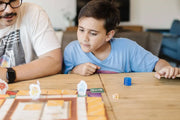
The good news is, predictable play, especially quick board game routines, can lower stress, strengthen coping skills, and rebuild the academic confidence that summer may have impacted.
To help you and your children cope with the school year beginning once again, we’ve compiled five big ideas for easing those back-to-school jitters, plus ready-to-use play plans featuring some of our favorite SimplyFun games.
With these tools, you’ll be helping your child practice emotional regulation, social confidence, and core skills, without it feeling like “school work” when school work is just around the corner!
Why Play Helps Calm Back-to-School Anxiety
1. Play is a natural (and entertaining!) stress regulator.
When kids play, they have the opportunity and space to choose, experiment and master small challenges. That sense of control and competence reduces stress hormones and supports healthy development. The American Academy of Pediatrics calls play “essential” for cognitive, language, self-regulation, and social-emotional growth, and encourages parents to prioritize playful learning for better overall resilience.
2. Games create safe, repeatable exposures.
Back-to-school anxiety is often about the unknown: “Will I remember what to do?” “What if I can’t keep up?” “What if I can’t make a friend?” “What if the teacher doesn’t like me?” Board games deliver low-stakes practice with rules, transitions, and problem-solving, mimicking the kinds of structures kids face at school. The more games are played, the more they’re exposed to a ways to make the daily routine feel less intimidating.
3. Play strengthens relationships.
Family game time boosts communication, connection and team work. These are all protective factors that help kids face hard things like first-day jitters or anxiety of an upcoming event. Even short, consistent “mini-game” routines build a sense of control that carries into the school day. It reminds kids they can do hard things and aren’t alone.
4. Games can directly reduce anxiety symptoms.
Board-game play has been proven to improve emotional states and, in some contexts, reduce anxiety and depressive symptoms. They also support attention and executive function, all skills that help kids manage worries and anxiety in the moment.
5. Play therapy principles apply at home.
There’s a reason clinicians and some therapists use play when interacting with children. Kids express feelings more freely through play than through talking. While therapy is a clinical service, parents can borrow the same principle: offer playful, mastery-oriented experiences that let kids “try on” coping in a safe space.
Make It Work: The 5-Step Back-to-School Play Framework
Using these five steps can help you turn short game sessions into calming rituals that can easily lower and help manage anxiety:
1. Predictability: Pick the same time to play a short game (10–20 minutes), with a simple start/stop ritual. Predictability reduces anticipatory worry.
2. Choice: Let your child pick between two games or two roles within a game. Choice restores a sense of control.
3. Scaffolded Challenge: Start easy, then add more complexity. This mirrors gradual exposure for children in every day situations. Kids practice tolerating mild discomfort or a loss in a game, and then can be more prepared to face things when things don’t go their way.
4. Co-Regulation: By showing your children some calm breathing techniques, curiosity, and flexible thinking when a turn goes sideways. Kids borrow your nervous system to steady theirs. They look to you to see how you handle changes in game play or outcomes, and then follow suit.
5. Transfer: End with a two-sentence “bridge” to school: “It was so great to see you keep trying different sums in the game until one worked. That’s the same persistence you can use on your math warm-up today.”
Games to Soothe Nerves & Rebuild Confidence
Below are some of our favorite SimplyFun games to fit our suggested Play Plans, including what skills you’re practicing (emotionally and academically), when to play, and how to adapt by age or need.
1. Alphabet Woods
2-5 players • 10 min • 5 & up
Skills: Alphabetizing & Sequencing

What it is: Players place alphabet letters to “grow” trees and add branches while practicing A-Z order. Kids collect adorable forest creatures along the way. It’s a quick, visual, and satisfying game for early readers!
Why it calms:
• Predictable sequencing is soothing. Putting letters in order offers a concrete win for kids who worry, “I forgot everything this summer.” It boosts their confidence.
• Mastering small tasks builds confidence for classroom routines that rely on following steps (lining up, cleaning up, center rotations).
Play Plan (Morning Warm-up):
• Time: 10 minutes after breakfast during the week before school and the first two weeks back.
• Start Ritual: “Let’s grow one ABC tree before we put on our sneakers!”
• Scaffold: Start with A–G only. Add letters in chunks as your child relaxes into the game.
• SEL Coach Lines: “You noticed G comes after F even when it felt tricky. That is a really great job!”
• Bridge this lesson to something at School: “When you see the ABC line on the wall at school, your brain will remember this game and how you know what to do!”
• Modify: For older kids who’ve mastered ABC order, set a cooperative goal: everyone completes one tree together in under 5 minutes. Cooperation amplifies the belonging effect.
2. Glow Spotters
2-4 players • 15 min • 5 & up
Skills: Addition & Spatial Reasoning

What it is: Join the Glow Spotters Troops on a firefly adventure! Roll the die, gather glow tiles, and use addition to match the numbers on your firefly boards. Solve the spatial reasoning challenges to complete your boards first and earn your Firefly badge.
Why it calms:
• Math without pressure refreshes number fluency that can fuel worry in the first weeks of school.
• The tactile, visual nature of gathering tiles and solving small spatial puzzles occupies the anxious brain and channels energy into problem-solving in a simple way.
• Quick wins (completing a board, earning a “badge”) reinforces that the child can do hard things. Research links game-based learning with gains in engagement and emotional regulation that lower school-related stress.
Play Plan (After-School Reset):
• Time: 15 minutes right after snack.
• Start Ritual: “Let’s fill one firefly board, then we’ll check your backpack together and see what went on at school today.”
• Scaffold: Begin with number targets your child can already add mentally (ex: sums to 10). Progress to larger totals as confidence grows.
• Coping Skill Add-On: Before each tile placement, take “Firefly Breaths” (inhale 3, exhale 4) to keep play steady if frustration rises.
• Bridge to School: “When we played Glow Spotters, you tried two different ways to make 12. Now you’ll know how to add different numbers to get the number you need, because you played the game!
3. Eagle Chase
2-5 players • 30 min • 10 & up
Skills: U.S. Geography & History

What it is: Hit the road and explore the U.S.! Discover fascinating geography and history as you visit iconic and hidden spots. Roll the dice, play cards, and chase the Eagle for extra points. Be the player to rack up the most points as you visit all the famous sites.
Why it calms:
• Eagle Chase is a great way for families and friends to talk about places you’ve been to or want to visit in the U.S. Talking about familiar places and personal stories builds belonging and strong storytelling skills, which are powerful tools to combat the “unknowns” that drive anxiety.
• Planning routes and adapting to the Eagle’s movement exercises flexibility and planning, which helps kids manage jitters when plans change at school. Board-game studies note the benefits for cognitive and interpersonal skills that then translate to more cooperation in the classroom and among other students.
Play Plan (Weekend Confidence Builder):
• Time: 25–30 minutes on Saturday or Sunday afternoon.
• Start Ritual: “Why don’t you pick one state you’d love to visit and we’ll try to route through it.”
• Family Conversation Prompts: “When have we changed plans on a trip and it worked out?” “What’s something new at school you want to know more about?”
• Bridge to School: “You did a great job of changing your route after the Eagle moved. That’s the same flexibility you need to have when things change around at school.”
Stretch Idea: Print a simple U.S. map and let your child mark the spots you visited after the game. This helps them visualize their progress which reinforces their confidence in adapting to changes and new situations.
4. Do You Know Shakespeare?
2-5 players • 30 min • 10 & up
Skills: Literature Knowledge, Probability

What it is: Step into the world of Shakespearean fun! Test your knowledge with trivia and place your book pawns on the answers you think are right. Earn shillings for each correct answer and rack up points. Be the player with the most shillings after five rounds.
Why it calms:
• Lots of laughter and low-stakes recall rebuilds confidence without the pressure of grades.
• Social interaction: taking turns, having a good-natured debate, voting for answers, all these exercise the same SEL muscles needed for group discussions and presentations. Role-play/tabletop formats have documented benefits for social-emotional learning.
Play Plan (Evening Wind-Down for Tweens/Teens):
• Time: 20 minutes after dinner, put away all electronic devices!
• Start Ritual: “Everyone needs to pick a dramatic voice to use when they’re playing today!”
• Coping Skill Add-On: If a question stumps your child, practice a growth-mindset line together: “I’m not sure of that answer yet…can you give me a hint?”
• Bridge to School: “You spoke up with your idea even when you weren’t sure it was the right answer. That same courage is going to help you during class discussions.”
Final Thoughts

Back-to-school jitters are normal. We’ve all been there. By playing a short daily game, you’re giving your child three gifts: a predictable safe space, repeated practice with small celebratory moments, and quiet academic refreshers that make the classroom feel less scary. With board game play, confidence can grow: one quick, joyful turn at a time.
More on the Blog:
How Student-Led Learning Enhances Classroom Engagement
Aspirational Play Can Help Kids Explore STEM