Fluid Thinking for Kids: How Creative Games Help Children Learn to Think Flexibly

Written by: Liza Gresko, Mom and PR Specialist at Moss Tucker Group
Key Facts at a Glance
- ✓ Fluid thinking helps children adapt, problem-solve, recognize patterns, and think creatively in unfamiliar situations.
- ✓ Open-ended games encourage flexible thinking by allowing children to experiment, interpret ideas differently, and try multiple solutions.
- ✓ Creative play supports important lifelong skills like confidence, communication, adaptability, and problem-solving.
- ✓ Games like SimplyFun’s Asymbol and Artributes naturally build divergent thinking and imagination through playful interaction.
- ✓ Parents can encourage fluid thinking at home by asking “what if” questions, allowing room for experimentation, and celebrating creativity over perfection.
As a mom of three very different and rambunctious kids, I’ve noticed something interesting over the years: children rarely solve problems the same way.
One child carefully follows every instruction while another jumps in without a plan and somehow figures it out along the way. And then there’s always the child who comes up with a completely unexpected solution that nobody else even considered.
That ability to adapt, think creatively and solve unfamiliar problems is what is often referred to as fluid thinking, one of the most important skills our children can develop.
We spend so much time focusing on memorization, grades, and getting the “right” answer that it’s easy to overlook the value of flexible thinking. But in reality, kids need to know how to adjust, experiment, communicate ideas, and approach challenges in different ways. After all, life is not a written script. It’s full of unexpected challenges and outcomes.
That’s why I love games that encourage creativity and open-ended thinking instead of just repetition or anxiety over getting a correct answer. It’s a way to help my kids strengthen their confidence in adapting to situations, coming up with other solutions if things aren’t going the way they expected them to.
Games like Asymbol and ARTributes are great tools to help create opportunities for kids to practice problem-solving, abstract thinking, and creativity naturally, all while experiencing the joy and freedom game play brings.
What Is Fluid Thinking?
Let’s dig a bit deeper into this because it’s a term not many people are familiar with. Experts describe fluid thinking (or fluid intelligence) as the ability to “think abstractly, reason quickly and problem solve” without relying only on previously learned information.
In everyday parenting language, it basically means when you’re:
- Thinking on the spot
- Adapting when something doesn’t work
- Solving unfamiliar problems
- Recognizing patterns
- Coming up with creative ideas
It’s the kind of thinking kids use when
- They invent a new game
- Build something without instructions
- Create a painting with no direction
- Work out a puzzle
- Choose an unexpected way to bind crafts together
- Explain an idea
- Turn random household objects into other things (a towel becomes a superhero cape, for example)
You may also hear phrases like fluid intelligence, abstract thinking or fluid intelligence and divergent thinking. Those can sound a bit complicated, but they all connect back to the same principle: helping kids become flexible thinkers who can explore other possible answers instead of freezing or focusing on what they deem the correct or right answer.
The world our children are growing up in changes constantly. Technology changes. Schools change. Careers change. Kids need confidence in their ability to think through new situations, not just memorize information or repeat prior actions that may have worked in the past but don’t quite apply to the new situation.
Why Open-Ended Play Matters So Much
One thing I’ve learned as a parent is that some of the best learning happens when kids don’t even realize they’re learning. That’s exactly why open-ended games are so valuable and frankly, just plain awesome. Who knew such powerful skills could be built during a simple board game?
Unlike games with only one correct answer, open-ended games and creative games encourage kids to:
- Experiment
- Interpret information differently
- Try new things or approaches
- Explain their thinking
- Adapt and readjust when ideas fail
And honestly, watching this happen during family game night is fascinating.
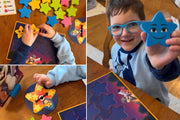
With Asymbol, for example, use 47 wooden shapes to build 3D forms based on cards showing things, beings, places, or events, while all other players try to guess. The first correct guesser and the builder each earn a point. The player with the most points at the end of the game wins.

What I love most is that the same pieces can become completely different things depending on the child using them. It’s a wonderful opportunity for open-ended thought as each player will likely create something completely different from another player, even if they’re presented with the same place or event.
One child might create a dragon. Another somehow turns the exact same shapes into a roller coaster. Yet another player could build something no one understands at all, which usually leads to a ton of laughter.
Fluid Intelligence and Divergent Thinking Go Hand in Hand
One thing researchers often connect to fluid intelligence is divergent thinking, which is basically the ability to generate multiple ideas or possibilities instead of searching for one perfect answer.
As parents, we actually see this naturally in children all the time and we may not even realize it.
Young children are amazing at divergent thinking because they haven’t learned to overthink everything yet. They’re also far more secure in themselves than many adults! They’ll happily imagine ten different uses for the same object or come up with wildly creative solutions adults would never consider, and present these solutions proudly and confidently.
But sometimes as children get older, they become more hesitant. They start worrying about being correct instead of being creative. They start second-guessing themselves out of fear: the fear of being wrong.
That’s why I love games like ARTributes, another stellar tool for building fluid intelligence and divergent thinking.

It’s a game where players tap into their imagination and vocabulary skills by drawing pictures based on wacky combinations of descriptive words, as other players guess what the picture is to score points.
The game encourages kids to think flexibly about descriptions, characteristics, and connections between ideas. There’s discussion, interpretation, and a lot of “Wait… I never thought about it that way!”
Those are the moments that are incredibly valuable because they help children realize there isn’t always only one way to think about something.
What Does a Fluid Thinker Look Like?
Fluid thinkers usually show up in everyday moments more than academic ones. They’re the people who:
- Adapt quickly
- Stay curious
- Try different strategies
- Ask creative questions
- Look at problems from multiple angles
- Keep experimenting when something doesn’t work
- Are confident in trying other ways to do things
and they often happen to be the children around you, as they:
- Build inventions out of random supplies
- Come up with unusual solutions
- Turn mistakes into new ideas
- Ask “what if?” constantly
- Have the confidence to try off-the-wall ideas
While some kids naturally lean toward flexible thinking more than others, it’s definitely something to encourage all kids to strengthen over time. Building confidence in their creativity and freedom to experiment are skills that will benefit them throughout their lives.
One of the Biggest Parenting Challenges: Letting Kids Struggle a Little
This is something I constantly have to remind myself, because as a parent your first instinct is to protect your kids and make their lives easier, not harder.
We naturally want to help our children immediately when they’re frustrated or struggling. But it’s flexible thinking that often develops during those moments when kids are trying to work through confusion or uncertainty on their own.
Sometimes instead of jumping in with the answer, it helps to ask:
- What else could you try?”
- “Can you think of another way to do it?”
- “What do you see right now?”
- “What are the problems?”
Even small moments like this help children become more comfortable with problem-solving and experimentation. You’re also helping them become secure in their decision-making, and supporting them in their journey to figure it out, whatever it may be.
reative games are wonderful for this because they provide low-pressure opportunities for kids to practice flexible thinking without fear of failure. They’re not in the middle of a presentation in front of the entire class. They’re at a table and just trying things out.
Nobody cares if your Asymbol creation looks ridiculous! The important lesson is how you got there and the fun you’ve had along the way. Sometimes the ridiculous guesses become the best part of the game.

Building Fluid Thinking Into Everyday Life
The nice thing about encouraging fluid thinking is that it doesn’t require complicated lessons or expensive programs. It doesn’t even require much (if any) effort on our part as parents.
It simply comes down to making room for creativity, curiosity, and conversation, and providing children with engaging tools.
Some simple ways to encourage flexible thinking at home:
- Play open-ended games together
- Ask “what if” questions
- Encourage storytelling and imagination breaks
- Let kids explain their thinking
- Celebrate creativity, not just correctness
- Allow room for experimentation and failure
Even something as simple as regular family game nights can help build communication, problem-solving, and confidence over time.
Games like Asymbol and ARTributes work especially well because they naturally spark creativity and conversation without feeling forced.
As parents, it’s easy to focus heavily on academics, grades, and measurable achievements. Those are absolutely important and have their place in children’s development and experiences. Some of the most important skills our kids will carry into adulthood are harder to measure, but no less important—things like creativity, adaptability, problem-solving, and confidence.
Those skills often grow the best through play. Whether kids are building imaginative creations or making innovative connections, they’re learning how to think flexibly, communicate ideas, and trust their own problem-solving abilities. Those are the kind of life skills that last long after game night is over.
Frequently Asked Questions
What is fluid thinking in children?
Fluid thinking, also called fluid intelligence, is the ability to think flexibly, solve unfamiliar problems, adapt to new situations, and come up with creative solutions without relying only on memorized information.
Why is open-ended play important for kids?
Open-ended play encourages children to experiment, communicate ideas, and approach challenges in different ways. It helps build creativity, confidence, adaptability, and problem-solving skills in a low-pressure (and fun-filled) environment.
How do games help develop flexible thinking?
Games that involve imagination, storytelling, strategy, or multiple possible answers help children practice trying new approaches, adjusting when ideas fail, and thinking creatively while having fun.
What are examples of games that support fluid thinking?
Games like Asymbol and ARTributes by SimplyFun are examples of games that encourage abstract thinking, creativity, communication, and divergent thinking skills.
How can parents encourage fluid thinking at home?
Parents can support fluid thinking by playing open-ended games, encouraging imaginative play, asking creative questions, allowing children to explain their thinking, and giving their children space to experiment and learn through mistakes.

Liza Gresko is a seasoned publicist at Moss Tucker Group with nearly 20 years of experience in the toy industry, helping brands tell compelling stories and connect with families worldwide. A mom of three, she's passionate about guiding families toward classic, educational toys and games that spark imagination and a love of learning.