Flip and Match in Spatial Reasoning Game, Poles Apart

Puffins and penguins may look like tuxedo cousins, but they will never meet in nature. That's because they live on opposite ends of the world! Puffins live in the northern hemisphere, while penguins live in the southern hemisphere.
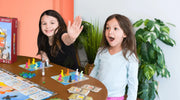
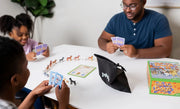
In SimplyFun's latest spatial reasoning meets matching game, Poles Apart, your goal is to strategically place fish, crab, penguin, and puffin tiles to create matches. The catch? They have to match when tiles flip into place. And whatever you do....make sure to keep puffins and penguins Poles Apart!
Families will flip over this tile-matching game where outcomes aren't always as they seem. Let's head to the North and South Poles to explore, Poles Apart!
Poles Apart: Object of the Game

In Poles Apart, players try to place their tiles strategically so that when a tile flips, it matches as many animals as possible without puffins and penguins touching.
While this may seem like an easy task, the direction card drawn each round determines how each tile will flip. Flipping a tile top to bottom, right to left, or diagonally can yield different outcomes when a tile is turned over. It's up to each player to imagine the mirrored matches on the other side and consider which will yield the highest points.
Tip: Be careful not to let penguins and puffins touch, which will result in zero points per turn.
Poles Apart: Skills at Play

Not only is it exciting to flip and reveal mirror reflections, but Poles Apart is also a great introduction to geometry and STEM-thinking! Let's explore how, with each flip and match, players give their brains a STEM-worthy flex!
Spatial Reasoning:
Spatial reasoning involves visualizing outcomes before taking action. Similar to an engineer visualizing the construction of a 3-D model and how each decision can alter its form and function. Coders, mathematicians, designers, and engineers all rely on this important skill to plan and problem-solve. Whether you’re planning animal matches in Poles Apart or deciding which steps to take to build a robot, spatial reasoning helps us picture possible outcomes and choose the best path forward.
Geometry:
In Poles Apart, players also learn the basics of rigid motions (also called isometries). This math & STEM skill focuses on geometric moves, such as flipping or sliding shapes without ever changing their size or shape.
Let's Get Ready to Play Poles Apart!
Curious to slide, flip, and match with Poles Apart on your next family game night? Keep reading as we explore game set-up, how to play, and scorekeeping. Game on!

Poles Apart Game Setup
1. Take 13 tiles at random and lay them out corner to corner, creating a seven-by-seven X on the table. This is the play area.
2. Divide the remaining tiles into as many equal stacks as there are players in the game. Place a stack in front of each player.
3. Return any spare tiles to the box.
4. Give each player a bird pawn and matching circular score pawn.
5. Place the score tracker near the play area.
6. Players place their score pawns near the "1" on the score tracker.
7. Place the 20-point tokens on Antarctica in the middle of the score tracker.
8. Shuffle the direction cards and set them in a deck on the card tracker.
How to Play Poles Apart:
To start the game, a player reveals the first direction card from the deck.

Direction Cards:
The direction card shows which way the player's placed tiles will be flipping after they are all placed in the current round.
There are different types of direction cards: red arrows point orthogonally (side to side and top to bottom), and yellow arrows point diagonally. The way the arrow is pointing is the direction that all players will flip at the end of the round. There are many possible directions: bottom to top, left to right, and even diagonally.
*Tip: When you flip your tiles, they stay in place. Tiles do not move locations or jump.
Placing Tiles

Once everyone knows the direction for the round, each player plays simultaneously. Looking at the top tile on their stack, each player tries to work out where in the play area they can place their tile to make the most animal matches after the tiles flip.
Remember, matches made before players' tiles flip do not earn points. It is only after all player-placed tiles flip in the direction indicated on the card that players will earn points.
The tile on top of your stack is the tile you place this round. Keep that tile on your stack and keep your stack on the table. You may spin your tile stack before you place your tile, but you may not lift or flip it over before placing it.

Play Notes:
- Players cannot place a tile next to another player's tile marked with a bird pawn. You must go back and move your tile to another valid location.
- Diagonal, or corner to corner, does not count as directly touching.
- When placed, your tile must directly touch at least one other tile, edge to edge with the white gutters of the tiles aligned, as shown in the example above.
- After you have placed your tile, put your bird pawn on top of the tile to show that your decision is final, and to remind everyone which tile is yours.
- You cannot move your tile again once the bird pawn is placed.
- When everyone has placed their tile and bird pawn, players carefully flip their tile in the direction indicated on the direction card for this round and place their pawns back on the respective tiles.
Scoring Points

After flipping everyone's tiles, it is time to earn points. For each group of matching animals you create with your tile, you earn 1 point per animal in the group.
For example, a pair of fish would earn 2 points, while 3 fish all touching would earn three points. Remember, it is only the position of the animals after your tile has been flipped that counts.
If, after the flip, you end up with a penguin next to a puffin on your tile, you score zero points for the round.
Play Notes: It is okay if your tile placement has a penguin and puffin directly touching before the flip. It is only after the flip that matters.
Tracking Scores

Track your scores by moving each player's score pawn on the score tracker as they earn points. When a player scores over 20 points, they take a 20-point token from Antarctica and continue to loop around the tracker. Once scoring is complete, players remove their bird pawns from their tiles. To start the next round, a player reveals the next direction card from the deck, and the game continues.
End of the Game
When all the tiles in players' stacks have been used and no one has any tiles left to place, the game is over. The player with the most points is the winner! If players tie, then they share the victory.
*Try This: For an easier game, try playing without the direction cards. Players may simply take a tile as is and race to find the best place in the play area in which to place it.
Behind-the-Scenes with Poles Apart

Love learning about the process of game design and what it takes to bring a game to life? We asked our Product Development Director, Tiffany O'Brien and Poles Apart's Artwork Designer, Laine Garrett everything you want to know about the development of this enchanting tile game!
Why did we select this game from the designer, and what about the concept made it feel like a perfect match for our educational collection and for fun, family play?
Tiffany O'Brien: We have one other game from our Poles Apart designer, Jack Hanauer in the line, The Reel Script. When we met with him to discuss other games, we played Poles Apart and I loved how it challenged my brain to think differently. I knew right away that this was a game that would invite players to activate spatial awareness in a new way. I love finding games that provide an interesting experience for parents and children so that we can all enjoy and grow together.
Later, when playing the prototypes with some math teachers, we uncovered the added bonus that this game teaches some difficult geometry basics when it comes to the x and y axis and reflections. When teaching this concept in the classroom, students often struggle to visualize the basics of isometry. As Poles Apart activates the understanding during gameplay, the hope is that when kids encounter rigid motions in geometry, they'll already have a leg up on learning.
Did the original game designer create any other SimplyFun games? If so, are there any commonalities between their games?
Tiffany O'Brien: Jack Hanauer designed The Reel Script, which is a storytelling game that activates imagination while teaching the elements of a plot. He also designed another game that will be releasing in 2026 that focuses on homophones. Jack Hanauer has a unique skill in creating games that teach tricky concepts that engage parts of our thinking that we don't often use. While the game mechanics vary greatly, the underlying teaching elements are very strong, all while providing delightful strategy.
Did SimplyFun make tweaks to the original blueprint of Poles Apart?
Laine Garrett: Originally, Poles Apart focused on Polar Bears and Penguins. We modified the game to highlight that Penguins and Puffins inhabit in the North and South Poles and therefore, would never find themselves together in nature. Other than that small tweak, the game is very similar to the original.
Any interesting challenges, fun details or aha moments during the illustration process and through game iterations?
Laine Garrett: The original game actually had a spinner to determine the direction tiles flip, instead of the direction cards the game has now. We opted to go the card route for multiple reasons, one of which was to make it so an even amount of diagonal and orthogonal flips happen each game. With a spinner, it could be weighted or truly random.
How long did Poles Apart take to produce?
Laine Garrett: We started around late 2023 and finished in the spring of 2024, but we had the prototype around for a while as we worked on other games.
What was your inspiration for the artwork?
Laine Garrett: We wanted the artwork to appeal to kids and adults equally, and that desire combined with the needs of gameplay informed the style. The art in the game is intentionally simple and icon-like because players need to easily recognize each corner of the tile, but the large mass of tiles all together as players add them need to not be a colorful chaos.
Any fun stories about where you found the inspiration?
Laine Garrett: Puffins are one of my favorite animals actually! We thought it was fun to have two birds, each from opposite sides of the earth, as the characters for this game, and highlight how things are similar yet so different in each polar area. Each bird has a black and white color scheme, with pops of orange and yellow. Similar, yet so different.
As a game designer & enthusiast, what do you love most about the game?
Laine Garrett: I like the dilemma of rushing to place your tile or taking your time. If you place quickly you can potentially get dibs on the best spot before anybody else!... but rushing things might lead to you failing to notice that a penguin touches a puffin after the flip and gain no points. I like the balance of knowing when to think quickly and knowing when you should take your time to think things through.

If your family is looking for screen-free fun that also sneaks in critical thinking and spatial thinking, add Poles Apart into your game night mix! Not only is it a fun brain-teaser as players explore the best matching opportunities in the play area, but with every flick of the wrist, you're splashing into early geometry too!
Get ready to shake up family time, because you'll flip over this brain-puzzle game where each play isn't always as it seems. Ready? Game on!