
-
A Vocabulary Skills Game

-

-

-

-

-

-


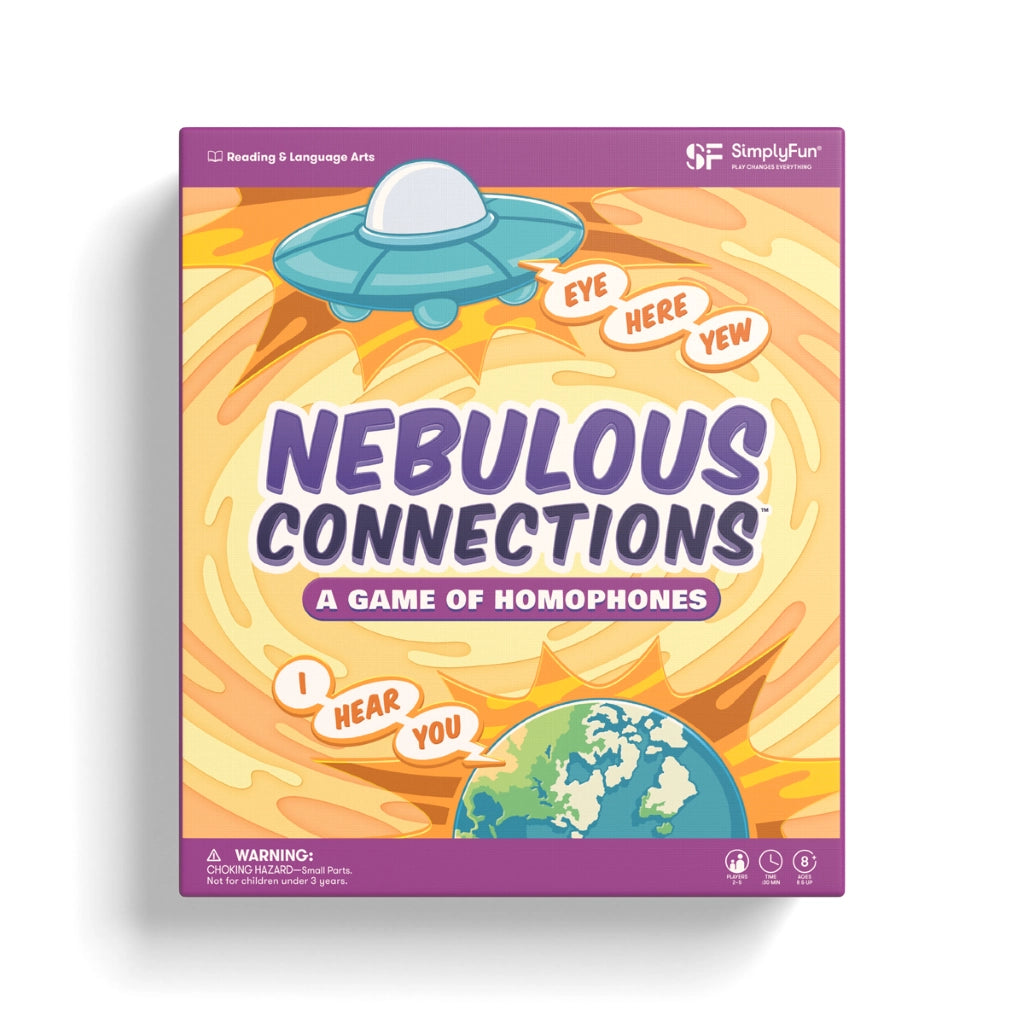

Nebulous Connections
Nebulous Connections

A shy Alien studied Earth’s language—but homophones keep causing confusion! In Nebulous Connections, players create clever connections between signal words and Earth words to score points. One player takes on the alien role, earning points for communicating like a true human. Build vocabulary, practice spelling and master homophones through fast, social play that sparks discussion and laughter.
Skills: Vocabulary, Spelling
Game Includes
Game Includes
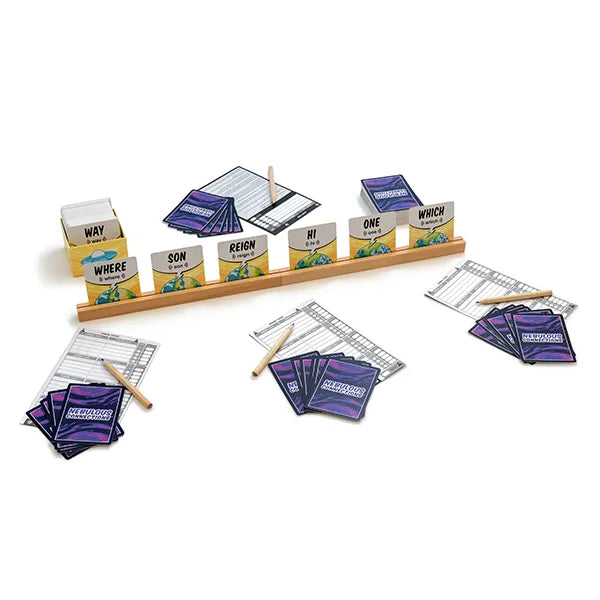
- 158 Signal Cards
- 160 Earth Cards
- 2 Earth Card Stands
- 1 Earth Card Box
- 5 Pencils
- 1 Score Pad
- 1 Rules Booklet


Collapsible content
You can play Nebulous Connections with two to five players, ages eight and up.
Players make connections between the cards in their hands and the homophones in play, building vocabulary skills. The reveal of each match expands language skills by allowing the discussion of definitions and the context of the word associations.
Additionally, homophones are very tricky words to spell because they are words that sound the same but are spelled differently. By writing words down, some of which are hidden, players can practice their spelling skills.
SETUP
The player reading these rules gets to be the alien for the first round. The other players will be humans. Humans all sit on one side of the table while the alien sits on the opposite side facing them.
These roles will change every round until each player has been the alien once.
Take a handful of signal cards from the box, shuffle them to form the signal card deck, and then deal out six signal cards to each player. Keep these hidden from the other players.
Place the Earth cards and their holder near the alien side of the table. Shuffle them if needed.
Place the Earth card stands side by side in the center of the table. Hold off on placing the Earth cards into the stands until the game starts.
Give all the players a score sheet and a pencil. As the alien, flip your score sheet over to the alien side.
OBJECTIVE
The goal of the game is to get the most points by making recognizable connections. Players get points when another player correctly guesses their intended signal and Earth card connection, and additional points for correctly matching signal and Earth cards played by other players.
The alien role is a little more difficult, so they get extra points for communicating like a local human.
STARTING A ROUND
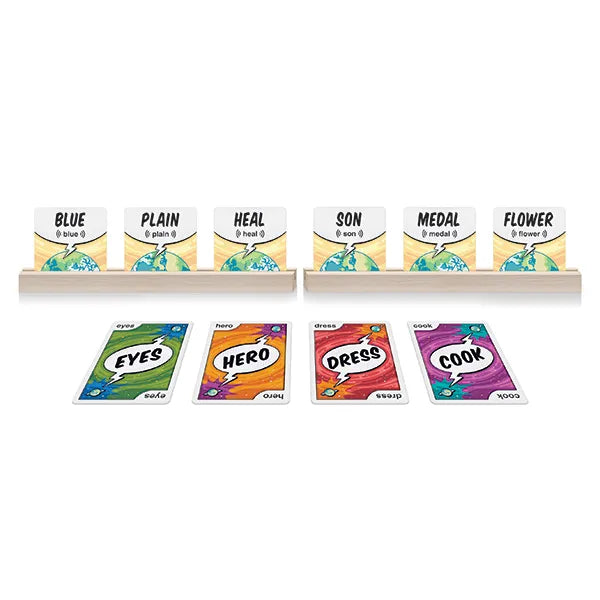
To start the round, the alien draws six Earth cards and places them into the stands, making sure that as they draw, they can see only one side of each card and the other side is only visible to the humans.
Each Earth card is double-sided with twin homophones, words that sound the same but mean different things, on the front and back.
Human players look at their cards and individually try to find the best match between one of their signal cards and one of the Earth cards.
You want the best connection between words you can find because you will get a point for every other player who guesses the same match you picked. There are no wrong choices, just choices that might be better than others.
Remember that the alien is seeing a different word that sounds the same on the other side, so it will benefit you to keep in mind how they might guess.
Once you have chosen a match, write down the card you've chosen and the Earth card it goes with in the topmost section of the score sheet on the human side. Then place the chosen signal card face down in front of yourself to indicate you are done.
THE ALIEN'S TURN
While the humans are picking words and cards on their side, the alien player is too. The alien sees different words from what human players are seeing, a homophone that sounds similar but has a different meaning.
As the alien, your goal is to match as close as you can to the homophones you cannot see. You will be rewarded if the humans cannot guess that your signal card belongs to an alien. Communicating like a local earns you extra points.
Once you have chosen a match, write the signal card you've chosen and the Earth card it goes with in the topmost section of the alien side of the score sheet. The alien side is found on the backside of the score sheet.
Once everyone has selected a signal card, the alien shuffles their card and all the human cards together, mixes them up, and places them face up where all the players can see.
GUESSING MATCHES
Now all players aim to correctly guess each signal card's intended Earth card.
First, write down each signal card that is not your own. Then in the column next to it, write which Earth card you think it goes with. Humans and aliens have the same goal here.
Note, everyone selected their pairings in secret, so it is possible that multiple signal cards go with the same Earth card.
You may write down the homophone from either side of the Earth card. So long as the word exists on that card, it counts as getting it correct.
When all players have finished making their matches, the humans will take an additional moment to select which signal card they believe was placed by the alien and mark that guess on their sheets.
Once that step is taken, it's time to score.
SCORING
To start scoring, the first human player tells everyone their signal card and which Earth card it's paired with.
Everyone, including the alien, who got the word pairing right raises their hand, and each player with their hand up gets a point. The first human player also counts the number of hands and gets that many points.
The human players each take turns going down the line telling everyone their pairing.
Next, the alien tells everyone their card and their match.
Everyone who got the word pairing right puts their hand up, and each player with their hand up gets a point. The alien player also counts the number of hands and gets that many points.
Lastly, the alien asks who guessed that their card was the alien.
Each human who guessed correctly raises their hand. These players spotted the alien and were unaffected by their charm, so nothing changes.
The players with their hands down just inadvertently met a new friend. Their first act of friendship is allowing the new alien friend to copy their points. The alien asks how many points they earned that round and writes down the same amount in their clone points section.
SPELLING CHALLENGE
After points have been allocated, players get a chance to exchange one of their signal cards for a new one.
The alien asks each human, left to right, if they'd like to do a spelling challenge to exchange one of their signal cards for a new one.
If a player says yes, the alien selects one of the Earth cards and asks the human to spell the word on the side that only the alien can see.
Tip: as the alien, it's best to pick an Earth card that no player selected this round to make it a challenge.
Players may spell the word out loud or use the back of their score paper to spell it out in writing.
If a player gets it right, they may exchange one of their cards, placing it face up in a signal discard pile. Then the alien gives them two more signal cards so they have six cards again.
If a player gets it wrong, they don't exchange cards this round.
For any player who either said no or failed the spelling challenge, the alien gives them only one more signal card so they have six cards again.
Once all the humans have six cards again, the alien also draws back up to six cards in hand.
END OF ROUND
After all players have received new cards, the alien cleans up the center of the table by putting the played signal cards into the signal discard pile and removing the Earth cards from the stands and placing them at the back of the Earth card holder.
Now a new round begins and another player becomes the alien.
Players shift clockwise, bringing their cards and sheet with them, so the previous alien moves to the human side and the human player next in line moves to the other side of the table and becomes the alien.
The new alien draws six new Earth cards from the front of the holder, places them in the stands, and a new round begins.
After all players have gotten to play as the alien for a round, the game is over and the player with the most points from all the rounds is the winner.
SimplyFun's Nebulous Connections is a game of homophones and vocabulary that is out of this world.
Core Standard*: Speaking & Listening, Language, Math
Speaking & Listening
- Speaking & Listening
- Comprehension and Collaboration Grade Levels 3rd, 4th
- Presentation of Knowledge and Ideas Grade Level 4th
Language
- Language
- Conventions of Standard English Grade Levels 3rd, 4th
- Vocabulary Acquisition and Use Grade Levels 3rd, 4th
Math
- Standards for Mathematical Practice
- Reason abstractly and quantitatively. Grade Levels 3rd, 4th
Explore
What Does Child Do To Use Skill In The Game?
The way players explore in Nebulous Connections is by thinking about possible relationships between your signal cards (example Pirate, Drum, Laugh) and the earth cards (example Ship, Sun, Muscle).
How Parents Can Assist Learning
While children probably do not require support, it may be helpful to talk about and provide examples of homophones when learning to play the game.
Learning Implications and Educator Support
Nebulous Connections is full of literacy development skills including homophones, verbal communication, and concept associations which are foundational for similes, metaphors and creative writing.
Determine
What Does Child Do To Use Skill In The Game?
Players ultimately need to decide which two cards the want to relate to each other.
How Parents Can Assist Learning
While children probably do not require support, it may be helpful to talk about and provide examples of homophones when learning to play the game.
Parents may want to ask questions during game play to expand children's vocabulary and creative thinking to make a Nebulous Connection such as "what are different definitions of Pirate?" or "where might you see or hear a Drum?"
Learning Implications and Educator Support
In addition to the skills listed in the Explore section, students will likely practice and learn new vocabulary playing this game.
Educators may want to provide hints if students are struggling to figure out what the homophone is on the opposite side of an earth card. Additionally, educators may want to ask questions during game play to expand children's vocabulary and creative thinking to make a Nebulous Connection such as "what are different definitions of Pirate?" or "where might you see or hear a Drum?"
Compare
What Does Child Do To Use Skill In The Game?
Playing Nebulous Connections involves comparing all of your signal cards to the earth cards to find possible relationships and then compare those in order to decide which to write down on their score sheet. Similarly, a player compares the signal cards places by others in an effort to accurately guess which connections those players made to earth cards.
How Parents Can Assist Learning
If you notice a child is not using the homophone feature of the game, remind them that there is one on the opposite side of each earth card. This can help with game play and literacy skill development.
Learning Implications and Educator Support
Other than the alien player, all players want their connection to be guessed by other players. Also, they want to accurately guess the connections made by other players.
This involves thinking about what other players may know or how they might think about the various relationships a player is considering on their turn. This perspective changing is also related to developing empathy, prediction, and other valuable life skills.
Remember
What Does Child Do To Use Skill In The Game?
Players will draw on their memory of the meaning of words and homophones of the words on the earth cards. They also can choose to spell words at the end of each round in order to exchange signal cards.
How Parents Can Assist Learning
If you notice a child is not using the homophone feature of the game, remind them that there is one on the opposite side of each earth card. This can help with game play and literacy skill development.
Similarly, if they are using only one definition of a work, you can remind or teach them about alternative definitions. For example, Pirate can a 1) person who robs or commits illegal violence at sea or on the shores of the sea and 2) a person who uses or reproduces the work or invention of another without authorization.
Learning Implications and Educator Support
A central skill required to play Nebulous Connections is memory of word definitions and homophones. The game also draws on student's recall of how to spell words.
To enhance the educational value of the game, educators may want to select earth and/or signal cards for game play. In advance of starting the game, the educator can introduce additional definitions for words to expand students' vocabulary. For example, students will likely think Steel is defined as metal or, more accurately, a metal alloy. However, they may not know that it can also mean 1) to fill with determination or resolve and 2) having a quality like steel strength such as "a grip of steel" or "nerves of steel".
Plan
What Does Child Do To Use Skill In The Game?
Because a player wants other players to pick their connection, Nebulous Connections involves a little planning as part of a player deciding which signal to earth card connection to make.
How Parents Can Assist Learning
Other than the alien player, all players want their connection to be guessed by other players. Also, they want to accurately guess the connections made by other players.
This involves thinking about what other players may know or how they might think about the various relationships a player is considering on their turn. This perspective changing is also related to developing empathy, prediction, and other valuable life skills.
Learning Implications and Educator Support
Other than the alien player, all players want their connection to be guessed by other players. Also, they want to accurately guess the connections made by other players.
This involves thinking about what other players may know or how they might think about the various relationships a player is considering on their turn. This perspective changing is also related to developing empathy, prediction, and other valuable life skills.
Practice
What Does Child Do To Use Skill In The Game?
Nebulous Connections is a great way to learn homophones through repeated play. For some children, it will also increase their vocabulary and improve their spelling.
How Parents Can Assist Learning
No special support required.
Learning Implications and Educator Support
The learning implications are set forth in the other skill sections. No special support required.
Solve
What Does Child Do To Use Skill In The Game?
Solving in Nebulous Connections involves trying to figuring out who the alien is and what connections the other players made.
How Parents Can Assist Learning
When all the chosen signal cards are revealed, each player needs to think about and decide which signal card connects to which earth card, and whom they think is the alien.
It may be helpful to remind children, especially during the first few times playing the game, that the alien needs to guess one of the words on the earth cards facing the Humans. Based on how all the other cards are played, this could give clues to whom the Alien player is.
Also, remind them that Humans can use the word facing them or their homophone.
Learning Implications and Educator Support
Whether you are the Alien or Human player, Nebulous Connections involves combining information, assessing possible connections, and evaluating how you think others players would connect their signal card to either side of an earth card in order to solve the questions, "Who made which connection, and who is the Alien?"
When all the chosen signal cards are revealed, each player needs to think about and decide which signal card connects to which earth card, and whom they think is the alien.
It may be helpful to remind children, especially during the first few times playing the game, that the alien needs to guess one of the words on the earth cards facing the Humans. Based on how all the other cards are played, this could give clues to whom the Alien player is.
Also, remind them that Humans can use the word facing them or their homophone.
*Data compiled from CCSSI ELA Standards, WA Science Standards, and Washington Social Studies Standards
Cognitive
Suggestions for How to Modify Play Experience
Nebulous Connections is not recommended for children with cognitive delays.
Communication
Suggestions for How to Modify Play Experience
Nebulous Connections will be extremely challenging for children with language delays.
Sensorimotor
Suggestions for How to Modify Play Experience
There are not many fine motor demands in Nebulous Connections, so children with sensorimotor concerns should be able to play the game as designed.
Social Emotional/Behavioral
Suggestions for How to Modify Play Experience
If children get easily frustrated, they may find this game too challenging.
Vision
Suggestions for How to Modify Play Experience
Reading the cards may be difficult for children with low vision.
Hearing
Suggestions for How to Modify Play Experience
Children who are deaf or hard of hearing may play the game, but may find homophones challenging and may have difficulty communicating with non-deaf players.
*Data compiled from CCSSI ELA Standards, WA Science Standards, and Washington Social Studies Standards
Autism Strengths & Interests
Short Summary of Strengths & Interests
- Vocabulary
- Language Arts
- Spelling
Is good at matching visual items
This game is not appropriate
Has a good memory for sensory details, including visual, touch, taste and smell
This game is not appropriate
Has a good memory for words, phrases and dialouge
Is This Game Appropriate? Yes
Description
If the child has a large vocabulary. However, many children with autism will be confused by the homophones.
Has a good memory for pictures, numbers and patterns
This game is not appropriate
Likes to put things in order or a sequence
This game is not appropriate
Learns through visualizing or "replaying" actions in their mind
This game is not appropriate
Likes activities with rules, such as math and phonics
This game is not appropriate
Is very concrete and literal
This game is not appropriate
Learns in small "chunks" (for example, phone numbers are 3 chunks of number xxx-xxx-xxxx that are combined together)
This game is not appropriate
Is good at nonverbal reasoning and logic
This game is not appropriate
Likes spatial problem solving
This game is not appropriate
Can read well with good vocabulary, though may not fully comprehend content
This game is not appropriate
Likes to use and has good fine motor skill
This game is not appropriate
Likes established routines or set ways of doing things
This game is not appropriate
Likes manipulating, constructing or building things
This game is not appropriate
Likes to use and has good musical abilities
This game is not appropriate
Likes to use and has good drawing skills
This game is not appropriate
Autism Special Considerations
Appears to ignore other's communication and/or has difficulty giving eye contact to a communication partner
Is This Game Appropriate for Child with Characteristic? No
Can Child with Characteristic Play Game w/o Modification? No
Strategies for Developing Compensatory Skills:
It is important to pay attention to others' responses in order to earn points.
Has difficulty understanding complex verbal directions
Is This Game Appropriate for Child with Characteristic? No
Can Child with Characteristic Play Game w/o Modification? No
Strategies for Developing Compensatory Skills:
The directions for Nebulous Connections are complex and may be confusing for many children with autism.
Uses vocabulary inaccurately or demonstrates echolalia (repeating another's speech)
Is This Game Appropriate for Child with Characteristic? No
Can Child with Characteristic Play Game w/o Modification? No
Strategies for Developing Compensatory Skills:
Understanding vocabulary is the foundation of the game. Players must connect concepts that may express a vague or unusual relationship. Repeating others' words may be distracting and confusing to other players.
Gets stuck repeating a verbal topic or physical actions and/or has difficulty attending to others' actions or topic.
Is This Game Appropriate for Child with Characteristic? No
Can Child with Characteristic Play Game w/o Modification? No
Strategies for Developing Compensatory Skills:
Focus of attention is important to play Nebulous Connections. Off-topic discussions or actions will distract players from the game sequence.
Has difficulty producing speech/communication
Is This Game Appropriate for Child with Characteristic? Yes
Can Child with Characteristic Play Game w/o Modification? Yes
Strategies for Developing Compensatory Skills:
Nebulous Connections does not require a talking because children are writing down their responses. However, players need to understand the nuances of vocabulary required and the relationships between concepts. They can play the game if they have strong vocabulary and can write down their responses.
Has difficulty sequencing multi-step actions and/or doing complex abstract tasks
Is This Game Appropriate for Child with Characteristic? No
Can Child with Characteristic Play Game w/o Modification? No
Strategies for Developing Compensatory Skills:
Several steps are involved in playing the game and scoring each round of Nebulous Connections.
Demonstrates difficulty initiating and maintaining social interactions
Is This Game Appropriate for Child with Characteristic? Yes
Can Child with Characteristic Play Game w/o Modification? No
Strategies for Developing Compensatory Skills:
Social interactions are part of the game, but players with autism can play if guided through each step of individual and group play.
Acts out or demonstrates avoidance behaviors when frustrated, overwhelmed, or needs more sensory input.
Is This Game Appropriate for Child with Characteristic? No
Can Child with Characteristic Play Game w/o Modification? No
Strategies for Developing Compensatory Skills:
Nebulous Connections requires focus of attention to both the individual and group aspects of the game. Behaviors inconsistent with all players attending will impede game play.
Has short attention span for non-preferred activities
Is This Game Appropriate for Child with Characteristic? No
Can Child with Characteristic Play Game w/o Modification? No
Strategies for Developing Compensatory Skills:
Unless the player with autism enjoys reading and has a good vocabulary, Nebulous Connections may not hold their attention.
Needs sameness or consistent routines and/or has difficulty with transitions from one activity to another
Is This Game Appropriate for Child with Characteristic? No
Can Child with Characteristic Play Game w/o Modification? No
Strategies for Developing Compensatory Skills:
Throughout the game, the vocabulary changes, and players are challenged to find new relationships between words. Although, the pattern of play remains consistent, players with autism may find the changing vocabulary frustrating.
Has difficulty understanding others' feelings, intentions, and the reasons for others' actions.
Is This Game Appropriate for Child with Characteristic? No
Can Child with Characteristic Play Game w/o Modification? No
Strategies for Developing Compensatory Skills:
Players do not need to understand others' feeling, but they should have insight into what other players may be thinking in terms of connections between words. This may be challenging for them.
*Data compiled from CCSSI ELA Standards, WA Science Standards, and Washington Social Studies Standards

Extra Ways to Play the Game
No expansions are suggested for Nebulous Connections
*Data compiled from CCSSI ELA Standards, WA Science Standards, and Washington Social Studies Standards
Game Details
- 158 Signal Cards
- 160 Earth Cards
- 2 Earth Card Stands
- 1 Earth Card Box
- 5 Pencils
- 1 Score Pad
- 1 Rules Booklet
- Choosing a selection results in a full page refresh.
- Opens in a new window.