
-
A Sight Words Skills Game

-

-

-

-

-

-


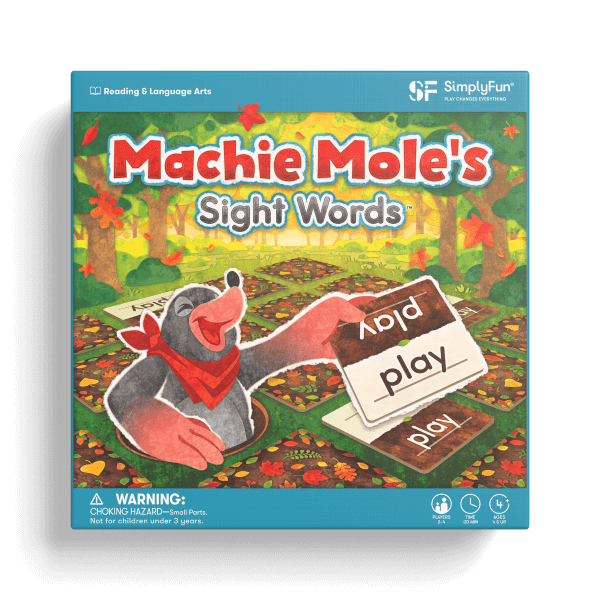




Machie Mole’s Sight Words
Machie Mole’s Sight Words

Skills: Sight Words, Early Reading, Memory
Game Includes
Game Includes
- 232 Cards
- 4 sets of Machie Mole cards (4 cards in each set)
- 9 sets of word cards (24 cards in each set)
- 30 Gold Coins
- 1 Shovel Pawn
- 1 Rules Booklet





Collapsible content
You can play Machie Mole’s Sight Words with 2-4 players, ages 4 and up!
Machie Mole’s Sight Words is great for Early Reading. Players read their cards out loud as they flip them, reinforcing what each word looks and sounds like.
Machie Mole’s Sight Words also helps develop Memory. Players watch and remember where words are located during other players’ turns so they can make those matches on their own turn.
There are nine sets of word cards in the box. Choose one set of word cards to play with, leaving the others in the box.
Take one of the four sets of Machie Mole cards out of the box.
Shuffle the word cards and Machie Mole cards together, and then lay them face down in a grid of five cards across and five cards down. Keep the remaining three cards hidden and out of play since these will not be used in this game.
Take the coins out of the box and set them aside where everyone can reach.
The last player who dug a hole is the starting player. Take the shovel pawn and give it to the starting player.
In Machie Mole’s Sight Words, players take turns trying to find matches to whatever card is marked by the shovel pawn.
As players turn over cards looking for matches, they read each word out loud for our friendly mole to hear. For each match a player makes, they earn a gold coin. The player with the most gold coins at the end of the game wins!
The starting player chooses any card and turns it over. If the card is a word, they read the word out loud. This will be the active card for this turn. Move the shovel pawn on top of the active card to keep track of it.
Next, the player chooses a second card to turn over and says the new word out loud. If the two cards match, the player continues to turn over cards until a card is turned over that does not match.
If the cards do not match, the player places the shovel on top of the non-matching card. If the player made any matches before that, they collect one gold coin for each match they made.
Then they turn all the matching cards face down, leaving the card with the shovel face up. The current player’s turn is now over.
Play now passes to the next player in a clockwise manner. The next player is now searching for the cards that matches the face-up card marked with the shovel.
Sometimes a player will turn over a Machie Mole card. These cards work the same as the word cards; players want to match them with other Machie Mole cards. (It can be easier for younger players to match images than words. If players are struggling, for your next game try replacing the word card set with an additional Machie Mole set.)
End of Game
When the last coin is collected, the game is over. The player with the most coins is the winner! If multiple players are tied for the most, then they share the victory.
Get ready to dig deep and discover the joy of reading when you play SimplyFun’s Machie Mole’s Sight Words!

Core Standard*: Reading
Reading
- Foundational Skills
- Phonological Awareness Grade Level K
- Phonics & Word Recognition Grade Level K

Determine
What Does Child Do To Use Skill In The Game?
When players turn over a card, they need to simultaneously compare and determine whether it matches another card that is turned over. If a word the player is trying to match has been turned over before, they will try to remember and determine it is located.
How Parents Can Assist Learning
While adult assistance is probably not required, a parent may want to help a child who is having difficulty remembering where a word is located by pointing to the row and saying, "The word that matches with the one you turned over is in this row."
Learning Implications and Educator Support
The design of Machie Mole's Sight Words helps develop a student's matching, memory and spatial awareness skills as they build early fundamental reading skills by matching and saying sight words aloud. While adult assistance is probably not required, a teacher may want to help a child who is having difficulty remembering where a word is located by pointing to the row and saying, "The word that matches with the one you turned over is in this row." Or, have other students offer a similar hint, which promotes cooperation by making the game more social.
Compare
What Does Child Do To Use Skill In The Game?
When players turn over a card, they need to simultaneously compare and determine whether it matches another card that is turned over.
How Parents Can Assist Learning
No parent support is required.
Learning Implications and Educator Support
The design of Machie Mole's Sight Words helps develop a student's matching, memory and spatial awareness skills as they build early fundamental reading skills by matching and saying sight words aloud. Educators may want to also ask children to define the words they match to increase their vocabulary for words they may not yet know or confuse with homonyms like "there" and "their".
Remember
What Does Child Do To Use Skill In The Game?
In order to be most successful playing Machie Mole's Sight Words, it helps to remember where words that were revealed by turning over cards are located.
How Parents Can Assist Learning
While adult assistance is probably not required, a parent may want to help a child who is having difficulty remembering where a word is located by pointing to the row and saying, "The word that matches with the one you turned over is in this row."
Learning Implications and Educator Support
The design of Machie Mole's Sight Words helps develop a student's matching, memory and spatial awareness skills as they build early fundamental reading skills by matching and saying sight words aloud. While adult assistance is probably not required, a teacher may want to help a child who is having difficulty remembering where a word is located by pointing to the row and saying, "The word that matches with the one you turned over is in this row." Or, have other students offer a similar hint, which promotes cooperation by making the game more social.
Practice
What Does Child Do To Use Skill In The Game?
Playing Machie Mole's Sight Words helps children practicing recognizing, reading and pronouncing sight words while using spatial awareness and short-term memory skills.
How Parents Can Assist Learning
No parent support is required.
Learning Implications and Educator Support
In addition to practicing early reading skills, Machie Mole's Sight Words as a good game for practicing spatial awareness and building short-term memory skills. Educators may want to the playfulness and educational value of the game. For example, when a student turns over a card have them use the word in a silly sentence before they try to get a match. This expands their understanding of how to create sentences and use the vocabulary.
Solve
What Does Child Do To Use Skill In The Game?
During play, more words will be revealed as cards are turned over. This allows players to use their memory to make more and longer strings of matches which is the goal of the game.
How Parents Can Assist Learning
While adult assistance is not required, a parent may want to encourage a child to "Wait. Look. Think." about whether they have seen a word before. "Did you see it once? More than once? Where do you think you saw it?" This will help them spend enough time replaying prior moves in their mind to help recall where a match could be made. This will also help with impulsivity and planning. Using such verbal cues can give children a model for approaching future play as well as complex life choices.
Learning Implications and Educator Support
If an educator observes students acting impulsively, they may want to prompt them to "Wait. Look. Think." about whether they have seen a word before. "Did you see it once? More than once? Where do you think you saw it?" This will help them spend enough time replaying prior moves in their mind to help recall where a match could be made.
*Data compiled from CCSSI ELA Standards, WA Science Standards, and Washington Social Studies Standards
Cognitive
Suggestions for How to Modify Play Experience
As noted in the directions, the cards can be sorted so just Machie Mole's picture and a few easy words are available for lower functioning children. The child who is learning counting and letters can also set up the game, with 5 cards across and 5 cards down in alignment. This will help number sense and spatial awareness. Talk about "same" amounts of cards in each direction in order to create a square.
If the child knows a few letters (such as the letters in their name) have them find a match with words containing those letters. For instance, if their name is Robert, they could match with girl since they both have "r" in them.
Alternatively, an even easier approach is to pick out cards that start with the same letters, such as 'that' and "there". The players will still be matching and learning the letters, even if they don't know the words.
As the game proceeds, more and more cards will have been turned over to reveal the words on the cards. For children with cognitive delays, allow them to put the shovel on any card and guess one letter that might be in the word on the card underneath. If the word on the card contains the letter, the child gets a coin. Then turn the card over and move the shovel to any other card.
Communication
Suggestions for How to Modify Play Experience
To add to the playfulness and educational value of the game, when the player turns over a card, they have to use the word in a silly sentence before they try to get a match. This expands their understanding of how to create sentences and use the vocabulary. Other players can help out if the child is stumped.
Players who are not yet reading can name the letters on cards to see if they are the same and, thus, a match. Just recognizing the letters, then repeating the word after another person reads it, is good practice for letter recognition. Encourage the child to make the sound of the first letter in the word.
Sensorimotor
Suggestions for How to Modify Play Experience
Arranging the cards requires fine motor skill and spatial awareness. Children with fine motor concerns may find this difficult. Provide a ruler, yardstick or other straight edge as a guide for the child to line up the cards against, and move it to each side as the cards are filled in, saving the center for last.
Turning the cards over without messing up the board may be challenging for some children. Allow space between cards for fingers to easily access the edges of the cards. If children have difficulty lifting the cards, use a butter knife to slide under the card and lift is up, so it is easier to get the fingers around the card.
Social Emotional/Behavioral
Suggestions for How to Modify Play Experience
For players who get frustrated when other players know the words and they don't, modify the child's turn to make it easier. Allow them to put the shovel on any card and guess one letter that might be in the word on the card underneath. If the word on the card contains the letter, the child gets a coin. Then turn the card over and move the shovel to any other card.
Let the easily frustrated child pick the cards that they recognize from the decks to be used on the board. Mix them all up before placement.
Vision
Suggestions for How to Modify Play Experience
Machie Mole's Sight Words is not a good match for a blind child.
If the child has low vision, check to see if the letters and contrast are sufficient for the child to see and determine the word.
Hearing
Suggestions for How to Modify Play Experience
Children with a hearing impairment should be able to play the game, even if they can't hear.
Encourage the child who uses sign to finger spell the word and teach the other players as well.
*Data compiled from CCSSI ELA Standards, WA Science Standards, and Washington Social Studies Standards
Autism Strengths & Interests
Short Summary of Strengths & Interests
- Early reading
- Spatial memory
- Comparing & Matching
Is good at matching visual items
Is This Game Appropriate? Yes
Description
Machie Mole's Sight Words is a matching game. Children with autism are often good at matching visual items.
Has a good memory for sensory details, including visual, touch, taste and smell
Is This Game Appropriate? Yes
Description
This game requires good visual memory.
Has a good memory for words, phrases and dialouge
Is This Game Appropriate? Yes
Description
Some children with autism are good at pattern recognition, even if they can't read. Others have great skill at reading words, even if they don't always understand what they mean. Machie Mole is a good match for these children.
Has a good memory for pictures, numbers and patterns
Is This Game Appropriate? Yes
Description
Players of Machie Mole's Sight Words need memory for pictures (Machie Mole) and word patterns. Some children with autism are good very good at both of these, even if they can't read making this a good game for them.
Likes to put things in order or a sequence
Is This Game Appropriate? Yes
Description
Children may recognize the match by the letter order, or pattern, rather than by the word itself. This is an opportunity to build on that recognition by adding the word and meaning.
Learns through visualizing or "replaying" actions in their mind
Is This Game Appropriate? No
Description
No replaying is needed here.
Likes activities with rules, such as math and phonics
Is This Game Appropriate? Yes
Description
Although no math is involve, some phonics is needed. Even though sight words don't always follow phonemic rules, they still incorporate phonemic understanding.
Is very concrete and literal
Is This Game Appropriate? No
Description
Words are an abstract representation of the meaning of the word. That is why some children with autism can learn to recognize the letter-sounds patterns and can read, but may not understand what the words mean.
Learns in small "chunks" (for example, phone numbers are 3 chunks of number xxx-xxx-xxxx that are combined together)
Is This Game Appropriate? Yes
Description
Sight words are, in fact, small chunks of letters that are learned when seen frequently.
Is good at nonverbal reasoning and logic
Is This Game Appropriate? Yes
Description
Machie Mole's Sight Words requires both verbal and non-verbal reasoning. Remembering where the cards are in the spatial arrangement is non-verbal memory. Recognition of the words is verbal memory.
Likes spatial problem solving
Is This Game Appropriate? Yes
Description
Spatial memory is a key part of Machie Mole's Sight Words. If the child likes spatial problem solving this is a good game for them.
Can read well with good vocabulary, though may not fully comprehend content
Is This Game Appropriate? Yes
Description
Because the child is not reading a narrative, they do not have to understand the words they read in context. They just have to find and read the match.
Likes to use and has good fine motor skill
Is This Game Appropriate? Yes
Description
Fine motor skills are needed for setting up the board and turning the cards over.
Likes established routines or set ways of doing things
Is This Game Appropriate? Yes
Description
The game is played the same way every time. Only the words change.
Likes manipulating, constructing or building things
Is This Game Appropriate? No
Description
No building is involved.
Likes to use and has good musical abilities
Is This Game Appropriate? No
Description
Music is not involved in the game.
Likes to use and has good drawing skills
Is This Game Appropriate? No
Description
Drawing is not involved in the game.
Autism Special Considerations
Appears to ignore other’s communication and/or has difficulty giving eye contact to a communication partner
Is This Game Appropriate for Child with Characteristic? Yes
Can Child with Characteristic Play Game w/o Modification? Yes
Strategies for Developing Compensatory Skills:
Machie Mole's Sight Words does not require eye contact among players. They can focus on the board.
Has difficulty understanding complex verbal directions
Is This Game Appropriate for Child with Characteristic? Yes
Can Child with Characteristic Play Game w/o Modification? Yes
Strategies for Developing Compensatory Skills:
Directions for the game are not difficult to follow.
Uses vocabulary inaccurately or demonstrates echolalia (repeating another’s speech)
Is This Game Appropriate for Child with Characteristic? Yes
Can Child with Characteristic Play Game w/o Modification? Yes
Strategies for Developing Compensatory Skills:
Unless the child's echolalia is extensive and distracting for other players, it should not inhibit the game. Repetition of the words other players are reading may be helpful.
Gets stuck repeating a verbal topic or physical actions and/or has difficulty attending to others’ actions or topic.
Is This Game Appropriate for Child with Characteristic? No
Can Child with Characteristic Play Game w/o Modification? No
Strategies for Developing Compensatory Skills:
Players need to attend to the game area during other players' turns so they can remember where words are placed. Listening to others will also support remembering the words played.
Has difficulty producing speech/communication
Is This Game Appropriate for Child with Characteristic? No
Can Child with Characteristic Play Game w/o Modification? No
Strategies for Developing Compensatory Skills:
Part of the game is reading the words that are turned over.
Has difficulty sequencing multi-step actions and/or doing complex abstract tasks
Is This Game Appropriate for Child with Characteristic? Yes
Can Child with Characteristic Play Game w/o Modification? Yes
Strategies for Developing Compensatory Skills:
Machie Mole's Sight Words requires a sequence of simple actions, turning over cards until no match is able to be made. Players need to remember the rules for when to take a gold coin token and when their turn is over. This is straight forward and not difficult. If the child can recognize sight words, they should be able to play.
Demonstrates difficulty initiating and maintaining social interactions
Is This Game Appropriate for Child with Characteristic? Yes
Can Child with Characteristic Play Game w/o Modification? Yes
Strategies for Developing Compensatory Skills:
Social interaction is not needed, but should be encouraged. For example, players can comment on the words read such as, "Yes, that says 'when.'"
Acts out or demonstrates avoidance behaviors when frustrated, overwhelmed, or needs more sensory input.
Is This Game Appropriate for Child with Characteristic? No
Can Child with Characteristic Play Game w/o Modification? No
Strategies for Developing Compensatory Skills:
Machie Mole's Sight Words requires attention to each players turn. Acting out behaviors will hinder the child's attention and distract other players from play as well.
Has short attention span for non-preferred activities
Is This Game Appropriate for Child with Characteristic? Yes
Can Child with Characteristic Play Game w/o Modification? Yes
Strategies for Developing Compensatory Skills:
If the child likes matching activities and has good spatial memory, which many children with autism do, Machie Mole's Sight Words may be a good game for them.
Needs sameness or consistent routines and/or has difficulty with transitions from one activity to another
Is This Game Appropriate for Child with Characteristic? Yes
Can Child with Characteristic Play Game w/o Modification? Yes
Strategies for Developing Compensatory Skills:
Machie Mole's Sight Words is played the same way each time, although the words will change with each game. This consistent pattern of play should provide a familiar routine once the child is familiar with the game.
Has difficulty understanding others' feelings, intentions, and the reasons for others' actions.
Is This Game Appropriate for Child with Characteristic? Yes
Can Child with Characteristic Play Game w/o Modification? Yes
Strategies for Developing Compensatory Skills:
Understanding others' feelings is not needed to play the game. Understanding what other players may do in a turn may help develop strategy, but is not necessary to play the game.
*Data compiled from CCSSI ELA Standards, WA Science Standards, and Washington Social Studies Standards


Game Details
- 232 Cards
- 4 sets of Machie Mole cards (4 cards in each set)
- 9 sets of word cards (24 cards in each set)
- 30 Gold Coins
- 1 Shovel Pawn
- 1 Rules Booklet
- Choosing a selection results in a full page refresh.
- Opens in a new window.